











































































Heat on Contract: Industrial Storage Turns Cheap Hours into a Bankable Asset
Brick, carbon and molten-salt stores are moving industrial heat from the fuel bill to the balance sheet. The interesting part is not the hardware. It is the contracts now being written on it.
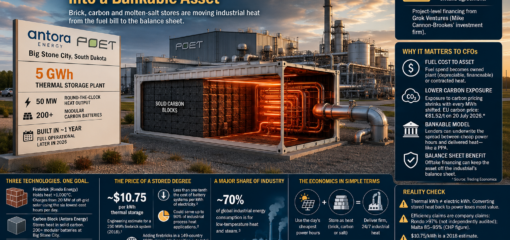
In May, the American biofuels producer POET and the Californian storage firm Antora Energy commissioned a 5 gigawatt-hour thermal storage plant beside POET’s bioprocessing facility at Big Stone City, South Dakota. More than 200 modular batteries store cheap electricity as heat in blocks of solid carbon; the plant was built in about a year and is due to be fully operational later in 2026. The scale drew the headlines. The finance deserves them. POET buys the output, 50 megawatts of round-the-clock energy, under a long-term heat offtake agreement, and the plant carries project-level financing from Grok Ventures, the investment firm of Atlassian co-founder Mike Cannon-Brookes. Process heat, the industrial cost that has resisted electrification longest, is being sold the way generators sell power: on contract, against an asset a lender can value.
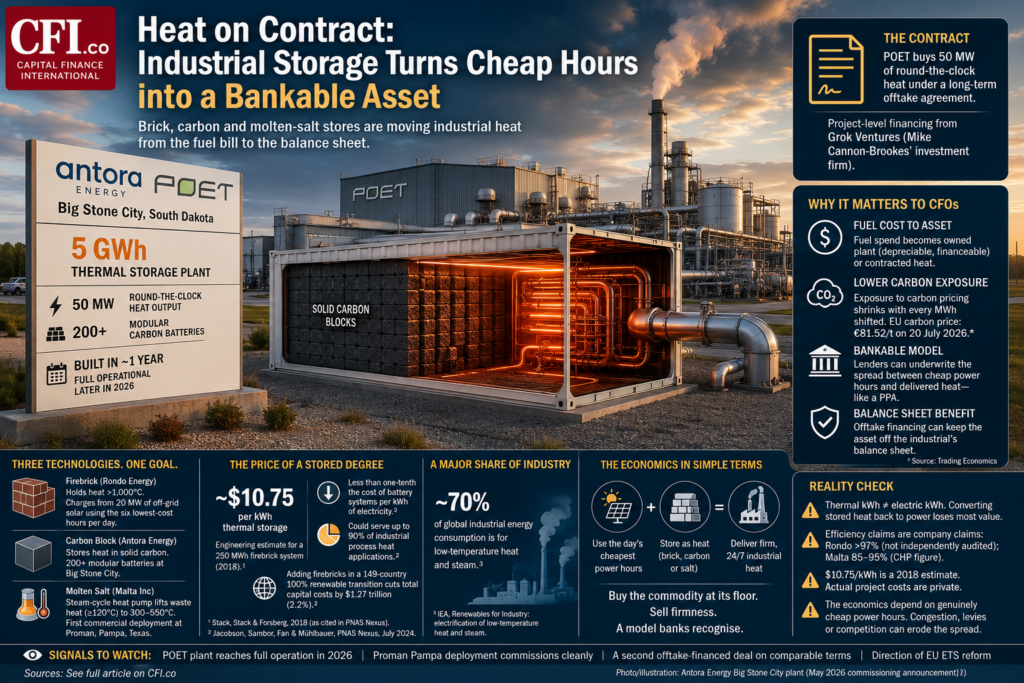
From cheap hours to firm heat
None of the physics is new. Rondo Energy’s installation at a Holmes Western oil facility in California charges a firebrick store from 20 megawatts of off-grid solar and discharges continuous high-pressure steam; it entered daily automatic operation in October 2025. The bricks hold heat at over 1,000 degrees Celsius, and the system charges, the company says, using only the six lowest-cost hours of electricity per day. Antora’s carbon blocks work on the same logic at Big Stone City. Malta Inc takes a third route: a steam-cycle heat pump that lifts industrial waste heat of 120 degrees Celsius or more into process heat at 300 to 550 degrees, with molten salt as the store, now heading for its first commercial deployment at Proman’s methanol plant in Pampa, Texas.
When CFI.co examined industrial heat pumps in January, the argument was that waste heat was turning into an unexpected asset. Storage extends that thesis in time. Heat recovered or bought cheaply no longer has to be used the hour it exists; it keeps, at industrial temperatures, until the plant wants it.
The price of a stored degree
The cost base separates this from most electrification stories. The most cited engineering estimate, from Stack and colleagues, put a 250 megawatt-hour alumina firebrick system at roughly $10.75 per kilowatt-hour of thermal storage in 2018. Mark Jacobson’s group at Stanford, writing in PNAS Nexus in July 2024, notes that this is less than one tenth of what a battery system costs per kilowatt-hour of electricity, and estimates that firebricks could serve up to 90 per cent of industrial process heat applications. In their modelling of a 149-country transition to fully renewable energy, adding firebricks cut the total capital bill by $1.27 trillion, or 2.2 per cent.
The International Energy Agency (IEA) finds that industries dependent primarily on low-temperature heat and steam represent roughly 70 per cent of global industrial energy consumption. That is not a niche.
The balance-sheet translation
For a chief financial officer, the appeal starts with the fuel line. Fuel spend, an operating cost hostage to gas markets, becomes either owned plant (depreciable, financeable, hedged by design) or contracted heat under an offtake, which is how POET has structured it. Exposure to carbon pricing shrinks with every megawatt-hour shifted; European Union allowances traded at €81.52 a tonne on 20 July, per Trading Economics.
The offtake is the quiet innovation. A lender that can underwrite the spread between the day’s cheapest power hours and delivered industrial heat can finance the store the way it finances a power purchase agreement, off the industrial’s own balance sheet where that is preferred. Buying the commodity only at its floor, then selling firmness, is a business model banks recognise.
Reasons for scepticism
A thermal kilowatt-hour is not an electric one. The one-tenth cost comparison holds for electricity stored and delivered as heat; converting stored heat back to power surrenders most of the value, and Malta’s claimed 85 to 95 per cent round-trip efficiency is a combined heat-and-power figure, on the company’s own accounting. Rondo’s claimed round-trip efficiency above 97 per cent has not yet been independently audited, and none of these plants has an operating history longer than a few months at commercial scale. The $10.75 figure is a 2018 engineering estimate; actual project costs remain private.
The caveat that matters most is the spread. The whole economics rides on hours of genuinely cheap power, and network congestion, levy design or simple competition for those hours can all erode it.
Where it holds, and where it doesn’t
The case is strongest at sites with steam or process-heat demand below roughly 550 degrees Celsius and access to cheap intermittent power: the American Midwest, Iberia, Australia. It is weakest where policy keeps industrial electricity dear relative to gas; in Britain, as with heat pumps in January, the arithmetic still hinges on rebalancing levies.
Signals to watch
Two operational tests come first: whether the POET plant reaches full operation on schedule later this year, and whether Proman’s Pampa deployment commissions cleanly. The signal that matters most is a second offtake-financed deal closing on comparable terms. One contract is a novelty. Two are a template, the thing that turns hardware into an asset class. The direction of EU Emissions Trading System reform sets the carbon side of the spread.
The bottom line
Cheap hours used to be a trading anecdote. With a store big enough and a contract long enough, they become plant. The missing middle of industrial decarbonisation, too hot for conventional electrification and too cold to justify exotic solutions, is acquiring what it always lacked: not a subsidy, but a price.
Sources
Antora Energy and POET, commissioning announcement, 19 May 2026 (Business Wire); see also Antora’s own release.
Rondo Energy, Holmes Western project announcement, October 2025.
Malta Inc, technology and deployment pages (Proman, Pampa, Texas).
IEA, Renewables for Industry: electrification of low-temperature heat and steam.
Trading Economics, EU carbon permits, reading of 20 July 2026.
You may have an interest in also reading…

Breaking Down Biden’s 2025 Capital Gains Tax Proposal: What’s Really in Store
In President Biden’s proposal for the Fiscal Year 2025 Budget of the United States Government, one of the most talked-about

SegurCaixa Adeslas Emphasises Value Creation as a Way to Endure Its Sustainable Growth Strategy
The Spanish insurance company stands out for the digitalization of its proceses that allows it to offer more accesible, personalised

NJMPF: Empowering Financial Literacy & Exemplary Leadership
The KwaZulu-Natal Joint Municipal Pension / Provident Fund (NJMPF) has solidified its status as a leader in the retirement fund
