











































































The Continental Couplings: Can Rail Integration Unlock Latin America’s Economic Frontier?
Fragmented by geography and long neglected by coordinated policy, the rail networks of South and Central America are drawing renewed attention from governments and investors seeking lower logistics costs and less exposure to a single maritime chokepoint. The plans are ambitious and the arithmetic is compelling. What the record does not yet show is much track.
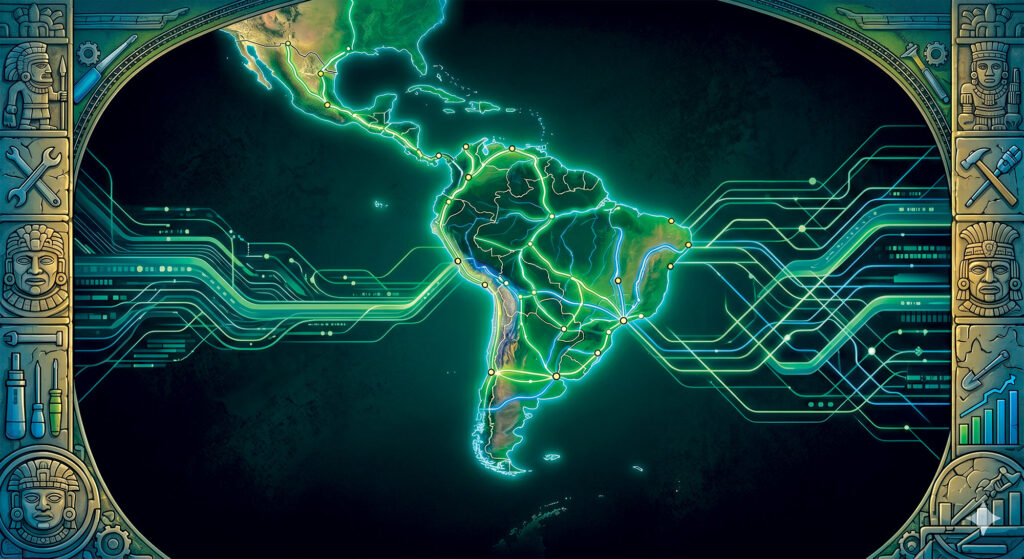
For much of the past century, Latin American railways were designed with a singular purpose. Built largely with foreign capital in the late nineteenth and early twentieth centuries, they functioned as extractive corridors, carrying commodities from inland regions directly to ports for export. Copper from Chile, beef from Argentina and coffee from Brazil flowed outward, but rarely across borders within the continent itself.
The result was a fragmented system. Neighbouring countries built to incompatible track gauges, making cross-border rail transport inefficient and often impractical. Today, as supply chains regionalise and sustainability considerations intensify, reconnecting these networks has moved up the policy agenda. Two projects carry most of the weight of that ambition: the bi-oceanic corridor intended to link Brazil’s Atlantic coast to a Pacific port, and Mexico’s interoceanic rail link across the Isthmus of Tehuantepec. They are at very different stages, and the difference is instructive.
The Cost of Disconnection
The economic case for rail integration rests on the cost of the logistics systems the region already has. The benchmark figure comes from the Inter-American Development Bank: in a 2011 study by Jose Luis Guasch, logistics costs across Latin America and the Caribbean were put at between 18 and 35 per cent of product value, against roughly 8 per cent in OECD economies. It is an old measurement, and no comparably authoritative update has displaced it, which is itself a comment on how little the underlying structure has changed.
Intra-regional trade remains correspondingly thin. The Economic Commission for Latin America and the Caribbean (ECLAC), in its International Trade Outlook published on 19 November 2025, put intraregional trade at 14 per cent of the region’s total exports and projected a decline to 13 per cent across 2025, as extraregional shipments grow faster than trade within the region. Integration, on this measure, is not merely incomplete; on the latest reading it is going backwards.
A key factor is the heavy reliance on road transport. Moving goods across vast distances, often through mountainous or forested terrain, is both costly and carbon intensive. Rail offers a scalable alternative, and the efficiency gap is large where it has been measured: the Association of American Railroads states that a single freight train can replace several hundred trucks, that railroads move one ton of freight nearly 500 miles on a gallon of fuel, and that rail is three to four times more fuel-efficient than road haulage. Those are United States figures, from a network with the density and volumes Latin America lacks, and they describe the prize rather than the present position. For sectors such as agriculture and mining, where margins are tight, closing even part of that gap would be decisive.
The Bioceanic Corridor: Thirteen Years of Studies
The most ambitious initiative is the bi-oceanic railway corridor, conceived in 2013 by the presidents of Bolivia and China, and designed to run some 3,750km from the Brazilian Atlantic coast through the Bolivian Amazon and the Andes to Peru’s Pacific port of Ilo. Railway Technology reported in March 2020 that the work divided into roughly 1,900km of rehabilitation in Brazil, about 1,500km of new build and upgrading in Bolivia and 340km of new construction in Peru, at an estimated cost of between US$10bn and US$15bn. Latin American development bank CAF had signed a US$3m agreement in October 2019 to fund pre-investment studies for the Bolivian section. Progress beyond that has been minimal, and at the time Brazil’s ambassador in La Paz stated plainly that the corridor was not a priority for the government of the day.
Momentum has since shifted towards a different alignment, running to Peru’s Chinese-built port at Chancay rather than to Ilo. Brazil and China signed a cooperation agreement in July 2025 to fund feasibility studies, and in January 2026 a Chancay–Sierra Central section was announced and reportedly awarded to a Chinese company. But as Mongabay reported on 31 March 2026, authorities confirm there is no approved definitive route: two broad options remain on the table, one crossing the southern Amazon through Madre de Dios, the other running through Pucallpa in Ucayali, and the project remains at a preliminary stage. Environmental specialists have raised substantial concerns about both, given the Amazonian and Andean terrain involved.
Readers will encounter confident claims that such a corridor would cut transit times to Asia by ten, twelve or fifteen days. Those figures circulate widely and attach to different routes in different tellings. With no approved alignment, no agreed terminal port and no engineering design, there is no basis on which any of them can presently be verified, and this publication will not repeat them. What can be said is narrower and still substantial: a functioning transcontinental rail link would give Brazilian and Bolivian exporters a Pacific outlet that does not depend on the Panama route at all.
The strategic case for that redundancy is real, though the immediate pressure has eased. The Panama Canal has recovered from the drought that cut daily transits to a fraction of capacity in 2023 and 2024. The Panama Canal Authority reported on 22 July 2026 that transits were averaging 35 vessels a day, with 10,726 transits between October and June, up 5.2 per cent year on year, and cargo of 389.96 million PC/UMS tons, up 7.2 per cent. The warning attached to that recovery is the point: the Authority put the probability of severe El Niño conditions at 81 per cent by July 2026, up from 25 per cent in April, with Administrator Ricaurte Vásquez stating that capacity restrictions would likely follow, through both draft limitations and reduced daily booking slots. A chokepoint that performs well between droughts is still a chokepoint.
For Bolivia, the corridor carries particular significance regardless of which alignment prevails. As a landlocked country, improved access to global markets would strengthen its economic position, and the development of inland logistics hubs would allow customs processing closer to production centres. That case has been made consistently for more than a decade. It has not yet been funded.
Mexico’s Interoceanic Strategy: The One That Is Running
In Mexico, a parallel initiative has moved from plan to operation. The Interoceanic Corridor of the Isthmus of Tehuantepec modernises the rail link between the Pacific port of Salina Cruz and the Gulf port of Coatzacoalcos. Line Z, the isthmus route itself, is operational, and Automotive Logistics reported on 13 January 2026 that President Claudia Sheinbaum expected the corridor to be complete by June 2026.
The commercial proof of concept has already been run. In early 2025 Hyundai Glovis moved 900 vehicles across the isthmus by rail in two batches, of 600 and 300, using 50 specialised freight cars, with the full journey across Mexico taking around six days. Sheinbaum has described the Panama Canal as saturated and positions the corridor as an alternative for containerised and vehicle freight.
The broader objective extends beyond transit. The corridor pairs the rail upgrade with designated industrial development zones along the route, intended to capture value from nearshoring as manufacturers relocate production closer to North American markets. By integrating transport infrastructure with industrial development, Mexico is attempting to build a logistics ecosystem rather than a simple land bridge. Whether the industrial half of that strategy delivers is not yet demonstrable; the transport half is carrying freight.
Standardisation and Interoperability
One of the principal technical obstacles to Latin American rail integration is the diversity of track gauges. Networks were built to different standards by different concessionaires, preventing seamless cross-border operation even where physical connections exist. The problem is not incidental to the corridor projects; it is one of the things the studies exist to solve, and technical and regulatory analysis to secure future interoperability between Bolivia, Brazil and Peru was written into the scope of the pre-investment work from the outset.
The engineering answers are well understood — common gauge on new-build international sections, dual-gauge track at critical junctions, and bogie-exchange or variable-gauge systems where conversion is uneconomic. Each carries a cost. Dual-gauge construction in particular raises capital cost and demands tighter alignment and maintenance tolerances, which is why it is generally reserved for junctions rather than whole routes. What has not yet happened is the adoption of a binding common standard across the three national networks a transcontinental corridor would have to cross. Until it does, interoperability remains a design intention rather than an engineering fact.
Financing the Network
The scale of investment required has drawn a range of financing sources. Multilateral institutions, including the World Bank and the Inter-American Development Bank, remain central, and CAF’s funding of the Bolivian pre-investment studies is characteristic of the multilateral role: small sums, early, to make a project bankable.
Chinese capital is the more consequential variable, and its record in the region is more mixed than the headlines suggest. Argentina’s Belgrano Cargas freight line is the case usually cited. Chinese financing there covered track modernisation and the supply of new locomotives and rolling stock, and it is worth being precise about the chronology: those arrangements were agreed under bilateral mechanisms that predate Argentina’s accession to the Belt and Road Initiative in February 2022. As Evan Ellis of the Center for Strategic and International Studies documented in June 2024, the programme subsequently became stuck at the end of the Fernández administration amid disputes running down to the sourcing of railway sleepers. Chinese infrastructure lending in the region is neither the uniform advance nor the uniform retreat it is often presented as, and projects should be assessed one contract at a time.
Green finance is frequently cited as the next source of capital, on the reasoning that rail’s lower emissions profile should qualify these projects as climate-aligned investments. The reasoning is sound and the instruments exist. Whether they have yet been deployed at the scale a US$10bn–US$15bn transcontinental corridor requires is a separate question, and on the present evidence they have not.
Social and Regional Impact
Beyond freight economics, rail integration carries broader social implications. The decline of passenger services in the late twentieth century contributed to the isolation of interior communities, and renewed investment offers the prospect of reconnecting them.
Mexico’s Tren Maya is the clearest expression of that ambition, its stated objective being to distribute tourism revenue more widely across the south-east; Line FA of the interoceanic corridor connects into that network. Greater connectivity is intended to support labour mobility, allowing workers to reach employment without relocating to major urban centres, and the development of secondary cities and commuter corridors may in time relieve pressure on the largest metropolitan areas. These are the projects’ objectives, stated by their sponsors. The distributional outcomes will take years to measure, and this publication will report them when they can be.
Digital Integration
Modern rail development is increasingly specified alongside digital systems: advanced traffic control, real-time consignment tracking and integrated logistics platforms. For shippers, the ability to monitor freight in transit and handle documentation electronically reduces uncertainty and administrative cost, and it is the precondition for genuinely multimodal transport, in which a container moves between rail, road and sea under a single set of documents.
Across most of the region this remains specification rather than installation. The corridor projects are being designed for it; the networks they would connect are, for the most part, not yet running it.
Toward a Connected Continent
The reintegration of Latin America’s rail networks represents a genuine shift in regional development strategy: away from the historic export corridor and towards internal connectivity and economic resilience. The logic is sound, the cost of the status quo is documented, and in Mexico at least the first corridor is carrying commercial freight.
The obstacles are equally documented. The transcontinental corridor has absorbed thirteen years of studies without producing an approved route. Intra-regional trade is falling as a share of the total. Chinese financing has proved capable of stalling as well as building, and the multilateral money so far committed is measured in millions against capital requirements measured in billions. The Panama Canal’s recovery has removed the immediate urgency that made the case easiest to argue, while the Canal Authority’s own El Niño warning is a reminder of why redundancy retains its value.
Rail in Latin America is not yet a central component of the region’s economic future. It is a credible candidate to become one, and the next two years — Mexico’s completion date, and whether the bi-oceanic corridor acquires an approved route — will indicate which. Those are observable milestones with dates attached, and they can be checked.
Sources
3. Association of American Railroads, “Freight Rail Facts & Figures”
You may have an interest in also reading…

CABEI’s AA+ Breakthrough: How a Smarter Balance Sheet Is Financing Central America’s Next Growth Chapter
The Central American Bank for Economic Integration (CABEI) has secured an S&P upgrade to AA+, capping a year of balance-sheet

Governance as Capital Protection: How UOB’s Board Architecture Reinforces Resilience in Singapore’s Banking System
For a systemically important bank, governance is not a compliance layer. It is a capital-protection system that determines how risk

More Than a Bank: Banco Azteca as a National Platform for Social Resilience
A financial institution’s value is not proven in moments of calm—it is tested in moments of crisis. Banco Azteca, one
