











































































The North Sea Cash Cow: What Happened to Britain’s Oil and Gas Windfall?
For four decades, North Sea oil and gas contributed heavily to Treasury receipts, supported Britain’s external accounts and influenced the politics of successive governments. Those revenues have not disappeared, but they are projected to fall to a fraction of their former scale. The explanation combines geology, commodity prices, investment economics, environmental policy and repeated changes to the fiscal regime.
There is a line in the Office for Budget Responsibility’s March 2026 forecast that would have surprised any Chancellor of the 1980s. Total receipts from UK oil and gas production—including offshore corporation tax, petroleum revenue tax and the Energy Profits Levy—were expected to reach £4.1bn in 2025–26 before declining to approximately £100m in 2030–31.
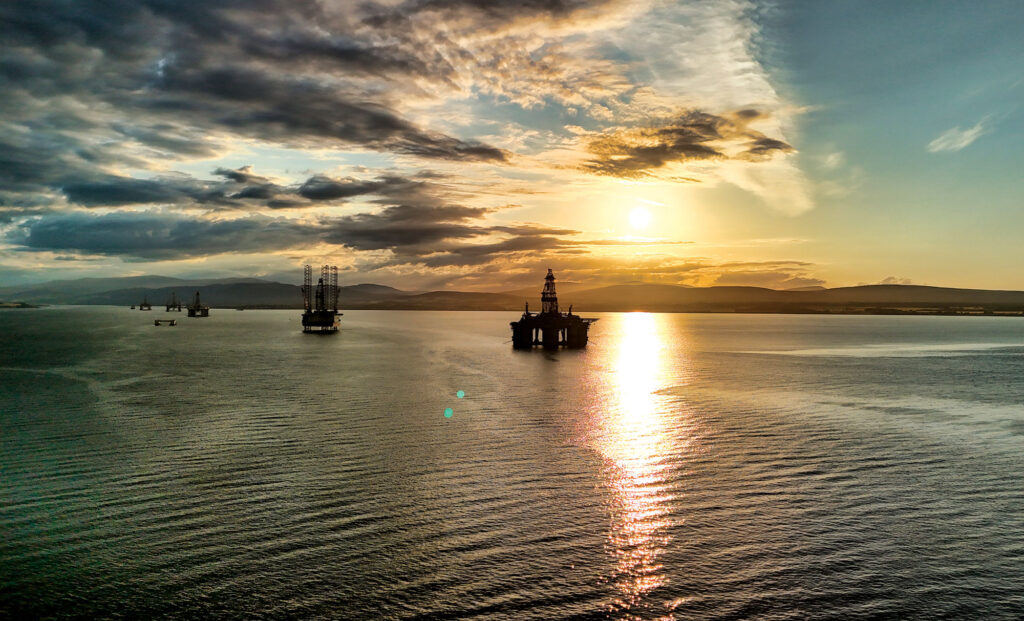
Invergordon, Scotland: Decommissioned oil platforms anchored in the Cromarty Firth
The forecast is not a prediction that the industry will have ceased to exist. It reflects assumptions about falling production, oil and gas prices and the expiry or earlier termination of the Energy Profits Levy. Forecasts can change materially with commodity prices, investment decisions and tax policy. The direction of travel, however, is difficult to dispute.
The term “North Sea” is commonly used as shorthand for the wider UK Continental Shelf, which includes production west of Shetland and in other offshore regions. Its decline is a story extending over more than four decades. Public debate often reduces it to a single culprit: ageing fields, oil companies, government taxation or climate policy. The evidence points instead to several forces acting at once.
The basin was always going to mature. The more difficult questions are whether policy accelerated its decline and whether Britain made lasting use of the fiscal windfall while it was available.
The Gusher Years
Gas came first. The West Sole field was discovered off Yorkshire in 1965, with production beginning in 1967. Its development helped support the conversion of British homes from manufactured town gas to natural gas.
Oil followed with major discoveries including Forties and Brent. Development accelerated after the oil-price shocks of the 1970s made difficult offshore projects increasingly attractive.
The first substantial North Sea oil came ashore in 1975. By the second half of 1980, the UK had achieved net self-sufficiency in oil—an unusual position for a large industrial economy.
The fiscal system developed alongside the platforms. Petroleum revenue tax was introduced to capture a portion of the economic rent from highly profitable fields, in addition to ring-fenced corporation tax and royalties.
Receipts increased rapidly. In 1984–85, government revenues from UK oil and gas reached £12bn, equivalent to approximately 3.1 percent of gross domestic product. They subsequently fell sharply before reaching another cash peak of £12.4bn in 2008–09, by then representing only 0.8 percent of a much larger economy.
North Sea production also strengthened Britain’s trade position during a period of industrial restructuring. Its tax receipts entered the Exchequer alongside other government revenues and helped ease the overall fiscal constraint. It is not possible to assign them directly to particular tax reductions or items of expenditure because the income was not formally ring-fenced.
The Fund Britain Never Built
The revenues were largely treated as current government income rather than accumulated in a dedicated national investment fund. This has encouraged an enduring comparison with Norway.
Norway transferred its first petroleum revenues into what became the Government Pension Fund Global in 1996. By the end of 2025, the fund was valued at more than NOK21tn, comprising petroleum transfers and decades of investment returns.
The comparison is instructive, but it is not exact. Norway and the UK had different population sizes, resource bases, fiscal positions, production profiles and political pressures. Britain was already using substantial North Sea revenues before Norway made its first transfer to the fund.
A British sovereign wealth fund would also have required either lower public spending, higher borrowing or higher taxation elsewhere. Its eventual value cannot simply be inferred from the present size of Norway’s fund.
The underlying distinction nevertheless remains important. Norway converted part of the income from a depleting resource into a diversified financial portfolio. Britain directed its receipts into general government finances. That was a political choice with benefits at the time, but it left no directly identifiable national asset when production and tax income began to decline.
Geology Gets a Vote
UK oil and gas production peaked in 1999 at approximately 4.4 million barrels of oil equivalent a day. The basin then began behaving like other mature petroleum provinces.
Production from the giant fields of the early North Sea era declined. Replacement discoveries were generally smaller, more technically complex and more expensive to connect. Existing installations also required increasing expenditure on maintenance, integrity and decommissioning.
The UK became a net importer of gas in 2004 and of oil in 2005. Average offshore production during 2025 was approximately 1.1 million barrels of oil equivalent a day, with total annual production of about 401 million barrels of oil equivalent.
Production is therefore approximately one-quarter of the 1999 peak. This long-term reduction is principally a consequence of reservoir depletion and basin maturity. Government policy can influence the speed and economics of decline, but it cannot restore the physical conditions of the peak years.
Investment patterns have changed as well. Following the oil-price downturns of 2014 and 2020, several international groups reduced their UK exposure or concentrated capital on larger and lower-cost opportunities elsewhere. Ownership shifted increasingly towards independent operators, some supported by private capital.
That made the basin particularly sensitive to operating costs, commodity prices, financing conditions and fiscal stability.
A Moving Fiscal Regime
The UK’s offshore tax system has been changed repeatedly since the 1970s, frequently in response to movements in oil and gas prices.
Governments have attempted to balance two objectives: securing an appropriate public return from a national resource and maintaining sufficient investment to recover commercially viable reserves. Those objectives become harder to reconcile as a basin matures and the remaining projects become smaller or more expensive.
The current core regime consists of ring-fenced corporation tax at 30 percent and a supplementary charge of 10 percent. The Energy Profits Levy, introduced in May 2022 following the sharp increase in energy prices, was initially set at 25 percent.
It was subsequently raised to 35 percent and then to 38 percent. This produced a combined headline tax rate of 78 percent on relevant profits. The levy is scheduled to end on 31 March 2030, or earlier if the statutory Energy Security Investment Mechanism is triggered by sufficiently low oil and gas prices.
The headline rate does not mean that 78 percent of revenue is collected as tax. Liability is calculated on taxable profits, and companies may receive relief for qualifying expenditure and losses. The dedicated investment allowance within the levy has been removed, although the decarbonisation allowance was retained and the underlying ring-fence regime continues to provide capital allowances.
The OBR’s March 2026 central forecast assumed that oil and gas prices would fall below the early-termination thresholds during 2027, causing the levy to stop raising revenue from the end of September that year. This assumption contributes to the steep decline forecast for later years.
Receipts illustrate the volatility involved. UK oil and gas revenues rose to £9bn in 2022–23 as energy prices increased. They fell to £4.5bn in 2024–25 as prices and production declined. The OBR expected £4.1bn in 2025–26, followed by a progressive fall to £100m in 2030–31.
These figures do not establish that higher tax rates necessarily produce lower revenues, or that tax reductions would pay for themselves. Revenues are affected simultaneously by prices, production, costs, allowances, investment and the timing of company payments. They do demonstrate how difficult it is to construct a stable tax base around a volatile commodity produced from a declining basin.
Investment Slows
Drilling activity provides another indication of the basin’s direction. According to the North Sea Transition Authority, operators drilled three appraisal wellbores and no exploration wellbores during 2025. Development activity also fell, although 38 development wellbores were drilled and expenditure remained at approximately £1.6bn.
The absence of exploration drilling cannot be attributed to tax policy alone. Geological maturity, licensing policy, available prospects, commodity prices, financing conditions and companies’ international investment options all affect drilling decisions.
Industry representatives argue that fiscal instability and the 78 percent headline rate have made the UK less competitive for international capital. Harbour Energy, for example, announced reductions to its Aberdeen-based workforce and attributed the decision principally to lower investment arising from what it described as a punitive fiscal and regulatory environment.
That explanation represents the company’s assessment. It does not by itself establish that taxation was the sole cause of the reductions, particularly in an industry already experiencing long-term production decline.
The end of refining at Grangemouth in April 2025 added to the sense of industrial retreat. The refinery became an import and distribution terminal. Its closure was commercially and politically significant, although refining is a downstream activity and its circumstances should not be treated as direct evidence of the effect of offshore production taxes.
Licences, Consents and Climate Policy
The government’s North Sea Future Plan, published in November 2025, confirmed that no new licences would be issued for exploration of new offshore fields. Existing fields may continue producing for their commercial lives.
The plan also created a route for limited production on or near existing fields through Transitional Energy Certificates. Such projects must be connected to established fields or infrastructure and cannot involve new exploration.
Rosebank and Jackdaw occupy a separate position because both were discovered and licensed before the change in policy. In January 2025, Scotland’s Court of Session ruled that their original consent decisions were unlawful because the environmental assessments had not included emissions expected from the eventual combustion of the oil and gas.
The judgment followed the UK Supreme Court’s decision in the Finch case. It did not impose an automatic prohibition on either field. Instead, the projects required fresh consideration under a process that accounted for downstream emissions.
The developers submitted further environmental information, and both projects remained under regulatory review in September 2026.
Industry groups and trade unions argue that proceeding with already-licensed projects could sustain employment, infrastructure and domestic supply during the energy transition. Environmental organisations contend that approving additional production would be inconsistent with climate objectives and could prolong dependence on fossil fuels.
The dispute concerns not only the volume of hydrocarbons involved, but the interpretation of a managed transition: whether domestic production should decline broadly in line with demand or whether supply restrictions should lead the process.
Security Returns to the Argument
For much of the 2010s, declining North Sea output was treated in Westminster principally as a consequence of geology and climate policy. The energy disruptions of 2022 and 2026 returned security of supply to the centre of the debate.
The Middle East conflict that began in February 2026 severely disrupted movements of oil and refined products through the Strait of Hormuz. Prices rose, governments released emergency stocks and the International Energy Agency described the interruption as the largest oil-supply disruption it had encountered.
The shock strengthened the argument that domestic production has strategic value. Oil and gas produced in the UK can reduce the volume that must be sourced internationally and can support domestic employment, infrastructure and tax receipts.
The limits of that argument are equally important. North Sea oil and gas are sold into international markets, so increased domestic production would not insulate British consumers from global prices. The remaining basin is also too small to determine those prices. Energy security depends on a combination of domestic supply, diversified imports, storage, infrastructure, efficiency and alternative sources of energy.
Domestic production can therefore reduce aspects of import exposure without creating energy independence.
What Comes After the Windfall Levy?
The government has begun establishing a permanent successor to the Energy Profits Levy.
Draft legislation published in July 2026 provides for an Oil and Gas Revenue Levy. It would apply after the existing levy ends and only during periods of unusually high prices.
Under the proposed design, the new levy would charge 35 percent on the portion of oil or gas revenue above specified thresholds. The initial thresholds are $90 a barrel for oil and 90 pence a therm for gas, adjusted annually for consumer-price inflation. The charge would operate alongside the existing 40 percent tax on ring-fenced profits.
Unlike the current levy, the proposed mechanism is intended to activate automatically in response to prices rather than remain continuously in force. The government says this should provide greater predictability while ensuring that the public receives an additional return during future price shocks.
Industry will judge the regime by its detailed operation, including how revenue is calculated, how costs are treated and whether the combined system allows marginal projects to compete for capital. The final provisions remain subject to the legislative process.
An Obituary, or a Second Act?
What happened to the North Sea cash cow? Geology explains much of the decline. The large, easily developed fields depleted, while replacement projects became smaller and more expensive.
Commodity prices also played a substantial part. The downturns of 2014 and 2020 reduced investment appetite and encouraged companies to direct capital towards projects elsewhere.
Policy influenced the remaining margin. Repeated fiscal changes increased uncertainty, while restrictions on new exploration and more demanding environmental assessments reduced the range and speed of potential developments. At the same time, those policies reflect legitimate public objectives: capturing value for taxpayers, meeting climate commitments and managing an orderly transition away from fossil fuels.
It would therefore be misleading to present the basin’s decline as entirely natural or entirely self-inflicted. Governments affect the rate at which investment and production fall, but they do not control the geology or the international price of energy.
The deeper question concerns the treatment of the original windfall. North Sea production generated very substantial public revenues, but Britain did not convert a defined portion of them into a permanent national fund. Norway demonstrates one possible alternative, although not one that could have been copied without significant fiscal and political trade-offs.
There is an interesting contrast thousands of miles to the south. The Falkland Islands, a British Overseas Territory whose sovereignty is disputed by Argentina, are preparing for potential oil production from the Sea Lion field under a fiscal system designed for a frontier development.
The comparison should not be taken too far. The Falklands have a much smaller population, a different constitutional position, higher frontier-development risks and a resource base at an earlier stage. Nevertheless, the islands will face a familiar question if production succeeds: how much resource income should be spent, and how much should be converted into assets capable of lasting beyond the field?
The North Sea’s lesson is ultimately less ideological than financial. Resource production declines. Commodity prices change. Tax policy influences investment, but cannot eliminate geological limits. Temporary receipts create permanent value only when governments use them to strengthen the balance sheet or build assets that survive the revenue stream.
Britain benefited from its offshore inheritance for half a century. The remaining challenge is to manage the decline without confusing what policy can influence with what geology has already decided.
You may have an interest in also reading…

Get NEDs, Get Ahead: These People are Important for Your Business
Companies across industries are recognising the value that NEDs — non-executive directors — bring to their boards. NEDs: do we

The “Barbarous Relic” That Refuses to Die: Gold at the Crossroads
John Maynard Keynes described the gold standard—not gold itself—as a “barbarous relic”. Yet the metal has returned to the centre

It’s All About Strategy — and Eurofer Has That Under Control
Italy-based Eurofer Pension Fund exploits the potential of diversification and risk-adjusted returns. In today’s dynamic financial environment, pension funds must
