


















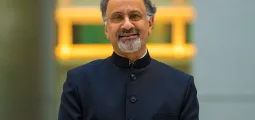

























































Ezio Lattanzio: Building Public-Sector Transformation With Discipline, Independence, and Purpose
In a consulting world often driven by scale, speed, and fashionable narratives, Ezio Lattanzio has built a different kind of leadership model. As Founder of Lattanzio Group, he has shaped a firm defined by strategic independence, cultural coherence, and a long-term commitment to strengthening public administration through evidence, innovation, and systemic impact.

Founder: Ezio-Lattanzio
There are leaders who grow companies quickly, and there are leaders who grow them deliberately. Ezio Lattanzio belongs firmly to the latter category. As Founder of Lattanzio Group, he has built a consultancy whose identity rests not on aggressive expansion or international uniformity, but on a more demanding set of principles: discipline, public value, cultural coherence, and a willingness to measure success not only by commercial growth, but by the real impact created for institutions and society.
That distinction matters. Lattanzio Group operates in a space where consulting is not merely a matter of technical advice or corporate optimisation. Its focus is public administration, an arena where change is shaped by political realities, regulatory constraints, bureaucratic cultures, and the expectations of citizens and businesses. In that context, leadership requires more than analytical skill. It requires judgement, patience, and a deep understanding of how institutions evolve.
Ezio Lattanzio’s vision is firmly future-oriented, but never abstract. This perspective has taken shape through long-term engagement with public administrations navigating complex reform cycles and policy transitions. It is further reinforced by his role at a European level as Honorary President of FEACO, the European Federation of Management Consulting Associations, where he contributes to shaping the broader direction and standards of the consulting profession. The company’s ambition is to act as an accelerator of public-sector transformation, helping administrations become more capable, more data-driven, and better equipped to generate long-term value. This is not consultancy designed to react to change after it arrives. It is consultancy intended to help public institutions anticipate, lead, and structure transformation in ways that endure.
That long-term lens is also visible in the way Lattanzio Group has approached growth. At a time when many advisory firms have pursued rapid expansion as proof of relevance, his model has been strikingly counter-intuitive. Growth, in his view, is not valuable if it dilutes impact. Consolidation has therefore often taken precedence over acceleration, demanding the discipline to pause, strengthen, and refine before resuming the next phase of expansion. It is a mature leadership philosophy, one that accepts uncertainty as part of decision-making and resists the temptation to confuse movement with progress.
The same logic shapes the group’s approach to acquisitions. Under Ezio Lattanzio’s leadership, M&A has not been treated as a simple instrument of scale. It has been approached as a strategic lever, subordinate to the company’s values, culture, and operating model. Cultural compatibility, integration quality, and strategic fit matter more than headline size. This is a governance approach that accepts complexity rather than denying it, and one that preserves the freedom to decide case by case, without surrendering to automatic formulas.
That independence is central to Lattanzio Group’s model. The firm has maintained a strong Italian identity while remaining internationally minded, a balance that is increasingly rare in an industry often shaped by the homogenising pressures of global networks. For Ezio Lattanzio, international ambition is not primarily geographic. It is cultural. It is expressed through sensitivity to context, respect for institutional specificities, and the patient work of building trust over time. Strategic openness exists, but only where it is aligned with long-term vision. Independence of thought and action is not treated as a branding device; it is protected as a source of value.
This leadership philosophy also explains the firm’s stance towards clients. Lattanzio Group does not position itself as a body that dictates solutions from above. Its approach is collaborative and enabling, designed to support administrations rather than overshadow them. The objective is to help the public sector become more competent, more effective, and more responsive to citizens and businesses. In practice, this means consulting that strengthens internal capability instead of creating dependency.
Innovation, within this framework, is understood in broader terms than technology alone. Ezio Lattanzio has consistently emphasised that transformation is effective only when digitalisation is integrated with strategy, processes, and impact assessment. Real innovation changes behaviour, not just systems. It reshapes organisational culture, decision-making habits, and the capacity of institutions to act with clarity and purpose. In this sense, technology is an enabler, but not the endpoint.
The public sector, of course, is never transformed in isolation. Lattanzio Group’s approach recognises that successful change depends on collaboration across multiple actors, including administrations at different levels, technical partners, and wider institutional ecosystems. He views this as a complex architecture that requires coordination, not a simple linear chain of command. Each stakeholder contributes an essential part of the solution, and leadership lies in aligning those contributions without losing sight of the wider public interest.
Data and evidence sit at the centre of that process. Decisions, in Lattanzio Group’s model, must be grounded in analysis and strategic alignment, with measurable value for clients and stakeholders. Choices that lack demonstrable impact are treated with scepticism. This insistence on evidence is particularly significant in the public arena, where resources are finite, scrutiny is high, and legitimacy depends on outcomes as much as intentions.
Yet perhaps the clearest expression of Ezio Lattanzio’s leadership lies in people. He has cultivated an environment in which teams are expected to combine rigour with listening, experience with openness, and methodology with curiosity. Talent development is not treated as a support function but as a core strategic priority. The aim is to build a professional community of consultants who understand not only technical frameworks, but their accountability for public impact.
That, ultimately, is the essence of his contribution. Ezio Lattanzio has built a company that treats change not as a project to be delivered, but as a culture to be sustained. His leadership reflects a rare combination of strategic independence, institutional sensitivity, and disciplined ambition. In a sector prone to overstatement, he has chosen a more demanding path: to create value slowly, coherently, and in ways that outlast the cycle of consultancy fashion. For Ezio Lattanzio, leadership is less about being recognised than about leaving institutions measurably stronger than before.
Sponsored content — written to CFI.co editorial standards
You may have an interest in also reading…

Natia Turnava’s Appointment as Governor of Georgia’s Central Bank: A Strategic Play for Stability and Investor Confidence
Georgia’s recent appointment of Natia Turnava as Governor of the National Bank of Georgia (NBG) signals a clear commitment to

SegurCaixa Adeslas Emphasises Value Creation as a Way to Endure Its Sustainable Growth Strategy
The Spanish insurance company stands out for the digitalization of its proceses that allows it to offer more accesible, personalised
Rate Holds Dominate as Major Central Banks Navigate a Fragile Global Economy
Monetary policymakers from the world’s largest economies are opting to play a cautious hand. This week, the US Federal Reserve,
