







































































Central Asia’s Mineral Exits: A Deal to Mine Is Not a Route to Market
By Lord JD Waverley
[email protected] | www.lordwaverley.com
Central Asia exports more than $15 billion of critical minerals a year, and every tonne must cross a neighbouring states border to reach the sea. With both southern exits operationally jammed in 2026, the routes that stay politically usable will decide who processes the ore and who holds the leverage.
Central Asia’s challenge has never been a shortage of minerals. It is getting them out that continues to be the issue. The five states export critical minerals worth is about $15.7 billion a year, according to the Oxus Society, which tracks the trade. Kazakhstan accounts for about $14 billion of that, mostly copper and uranium. Every tonne must cross at least one border, and often several, before it reaches the sea.
In 2026 that geography turned from a cost into a crisis. The US–Israeli war with Iran began on 28 February, Tehran closed the Strait of Hormuz, and in April the US blockaded Iranian ports. An April ceasefire broke down in May with a framework deal following on 14 June. For months, the southern gateway Central Asia had counted on was shut.
The Afghanistan–Pakistan border, meanwhile, has been closed to trade since 12 October 2025. It is still shut, stranding the most-discussed alternative before a single rail has been laid.
The result is a region with more corridor plans than ever and fewer reliable exits. Which routes survive will decide who processes Central Asia’s minerals, who earns the transit fees and who holds the leverage.
The Caspian route takes the strain
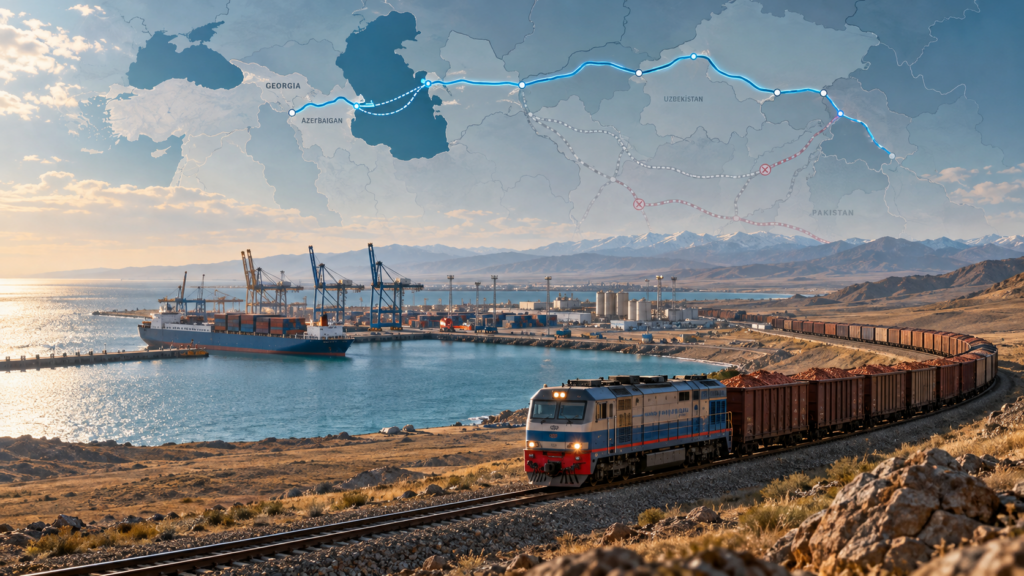
The Trans-Caspian International Transport Route, or Middle Corridor, has been the principal beneficiary of the year’s shocks, running from China across Kazakhstan, by ferry over the Caspian to Azerbaijan, and onwards through Georgia to the Black Sea and Turkey. Kazakhstan’s transport ministry says it carried 4.12 million tonnes in 2025, including about 77,000 twenty-foot equivalent units (TEU) of containers. Kazakhstan aims to lift the route’s capacity to 10 million tonnes a year by 2027. Together with China, it targets 300,000 TEU by 2029.
The war tested that ambition early. Rauf Agamirzayev, an Azerbaijani logistics analyst, put container demand on the route 450 to 500 per cent above the same week of 2025 within a week of the first strikes. He reported turnaround times at Aktau and Baku roughly tripling, with the weak points being ferry capacity, port depth and the Georgian exit. Port capacity on the Azeri side is not yet the binding one. The port at Alat, opened in 2018 with room for 15 million tonnes a year, handled 8.2 million in 2025, and a World Bank-backed expansion would take it to 25 million. Kazakhstan began main dredging at Aktau in October.
Georgia is the slower fix. Its Anaklia deep-sea port, meant to relieve Poti and Batumi, lost its Chinese-led consortium in July without an investment agreement ever being signed. Tbilisi now runs it as a state project. Belgium’s Jan De Nul began dredging in September, and the first phase is due in 2029.
The South Caucasus is also gaining a second line. The US-brokered Trump Route for International Peace and Prosperity (TRIPP) would cross about 42 kilometres of southern Armenia, linking Azerbaijan to its Nakhchivan exclave and on to Turkey. Turkey broke ground on a 224-kilometre Kars–Dilucu railway to meet it in August 2025. Neither Baku nor Yerevan expects work on TRIPP itself before 2027.
Yerevan insists on sovereignty over the route, while Baku wants unimpeded passage. Prime Minister Nikol Pashinyan’s June election win, which gave his Civil Contract party 64 of 105 seats, keeps the project politically alive.
Azerbaijan: the gateway, again
Every westward option across the Caspian now lands in Azerbaijan. The same was true of oil two decades ago. The Baku–Tbilisi–Ceyhan (BTC) pipeline, opened in 2006, made Azerbaijan the indispensable outlet for Caspian crude to world markets without crossing Russia or Iran. It also gave Baku lasting strategic weight with Western governments and energy majors.
Rail and ports are now repeating the pattern. The Baku–Tbilisi–Kars railway follows much of the BTC pipeline’s route, and TRIPP would add a second outlet through Nakhchivan to Turkey. Both begin at Alat. In August President Ilham Aliyev said Baku plans an international consortium for the Nakhchivan railway, with investors guaranteed transport volumes. That is the BTC model again.
The lesson cuts both ways. A single gateway brings investment and predictability. It also concentrates leverage. Kazakh, Uzbek and Turkmen exporters, and the Western buyers behind them, will increasingly depend on decisions taken in Baku.
South through Afghanistan: the Pakistan option
For doubly landlocked Uzbekistan, the prize is a direct line to the Arabian Sea. The Uzbekistan–Afghanistan–Pakistan (UAP) railway would run from Termez past Mazar-i-Sharif, through Maidan Shahr and Logar to Kharlachi on the Pakistani border, connecting to Karachi and Gwadar. Published lengths range from about 570 to 760 kilometres.
The price keeps rising. Tashkent’s earlier estimate was about $4.8 billion. In June Jasurbek Choriev, Uzbekistan’s deputy transport minister, has said it could now exceed $7 billion, with Pakistan putting it at $8.2 billion. The build would take at least five years, with a feasibility study due by the end of 2026.
Interest is broadening. Russia, eyeing an outlet on the Indian Ocean, said in April 2025 that 8 to 15 million tonnes of its cargo a year could use the line if the route proves competitive. On 30 September Kazakhstan, Uzbekistan and the UAE signed a memorandum to study a Central Asia–South Asia (CASA) rail corridor to Pakistani ports. It named no route, cost or investor. Kazakhstan had already offered, in January, to finance a different line altogether: west through Turkmenistan and Herat, entering Pakistan at Chaman.
The obstacle is political. Pakistan and the Taliban have fought repeatedly along the Durand Line. On 24 September Pakistani air and drone strikes hit ten sites inside Afghanistan. Multilateral lenders cannot easily finance a Taliban-run state. Gauge breaks between Central Asia’s 1520mm track and Pakistan’s 1676mm would also add transshipment costs, which matter for low-value bulk ore.
West through Afghanistan: the Iran option
The Iranian alternative is physically further ahead. Since 2020 a railway from Khaf in Iran has reached Rozanak in Afghanistan’s Herat province. In October 2025 Afghanistan, Iran and Türkiye agreed to build a roughly 657-kilometre line from Herat to Mazar-i-Sharif, costed at about $780 million. Afghanistan’s central bank says domestic commercial banks will fund it.
Iran’s own network is moving too. In late September the governor of Sistan-Baluchestan announced that track-laying was complete on the Chabahar–Iranshahr section of the Chabahar–Zahedan railway.
For Uzbekistan, a Mazar–Herat–Khaf link would offer a path to Iranian ports and Turkey that avoids Turkmenistan. For Tehran, battered by war, Afghanistan has become overland insurance against maritime pressure.
The drawbacks are plain. Iranian ports and railways were exposed to strikes this year, and any Western-financed mineral project routed through Iran faces sanctions risk. Pakistan, meanwhile, has become a back door into Iran: since April it has opened land routes for goods from Gwadar and Karachi to the Iranian border at Gabd and Taftan.
China profits from every exit
Whichever exit prevails, China is likely to profit. It holds 51 per cent of the China–Kyrgyzstan–Uzbekistan railway venture. In August Uzbekistan’s transport minister, Ilkhom Makhkamov, put construction at 17 per cent complete and said it could finish at least a year early. On the Caspian, China Harbour Engineering is the general contractor at Aktau. Beijing is helping to build the very corridor Western capitals describe as a hedge.
More important, China dominates processing. In 2025 it took 99.98 per cent, by value, of Kazakhstan’s exports of tungsten ore and concentrate. In Afghanistan, a consortium led by Metallurgical Corporation of China holds the concession for Mes Aynak, estimated to contain about 11 million tonnes of copper. Beijing reaffirmed in 2025 that it wants Afghanistan brought into the China–Pakistan Economic Corridor.
Washington is pushing back. Uzbekistan and the US signed a critical-minerals memorandum in February, and two US agencies, the International Development Finance Corporation and EXIM, followed with heads of terms for a joint investment framework. In Kazakhstan, Cove Kaz Capital, a venture announced at the November 2025 US–Central Asia summit, has signed definitive agreements with the state miner Tau-Ken Samruk for the Northern Katpar and Upper Kairakty tungsten deposits.
But a deal to mine is not a route to market. Without a reliable westward exit, Central Asian ore still flows east by default.
The Navoi test
Uzbekistan’s Navoi region shows the gap between corridor rhetoric and practice. Navoiyuran, spun out of Navoi Mining and Metallurgical Combine (NMMC) in 2022, supplies an estimated 8 per cent of the world’s uranium by its own account. Its customers include Canada’s Cameco, and France’s Orano is a joint-venture partner.
Yet when Navoiyuran hired a logistics firm in 2025 to move up to 6,000 tonnes of cargo to Malvési in southern France, the route ran through St Petersburg. For radioactive freight, Russia remains the proven option.
NMMC itself, among the world’s largest gold producers, reported net profit of $2.38 billion for the first half of 2026. Its planned listing in London and Tashkent, for which it had sought a valuation of about $20 billion including debt, has been paused, Bloomberg reported in May. That leaves open how far Western capital will be invited into Uzbek mining.
A shorter Uzbekistan–Kazakhstan rail link building on Navoi’s existing multimodal logistics centre, cargo airport, rail and road links and free economic zone, expanding them into a dry port and processing zone for critical minerals would help bridge this gap. If planned and structured with due thought and appropriate guidance, together with Navoi’s links south and east that would give Uzbekistan three export axes: north through Kazakhstan, west via the Caspian, and south and east.
Who gains, who loses
Azerbaijan is the clearest winner. Azerbaijan controls the Caspian landing point and stands to gain a direct link to Nakhchivan and Turkey. Turkey wins as the endpoint of both Caucasus routes. Uzbekistan gains leverage simply from having options, and Kazakhstan has backed every direction at once.
Pakistan’s position is the most awkward. Its planning minister, Ahsan Iqbal, champions the trans-Afghan line, yet Islamabad’s conflict with Kabul is what blocks it. The Taliban, whose deputy railways minister Mohammad Ishaq Sahibzada leads the technical talks, could gain transit fees and a measure of legitimacy. Georgia gains if Anaklia is delivered, and the departure of its Chinese consortium removes one complication from its Western pitch.
Iran stands to lose its role as Azerbaijan’s route around Armenia, and Russia stands to lose China–Europe traffic. Turkmenistan risks being bypassed unless Kazakhstan’s line through Herat is built. The UAE’s re-export trade could lose ground to land routes, which may be why Abu Dhabi signed the CASA memorandum.
Above them all sit Washington, which brokered TRIPP, and Beijing, which is building and buying on every side.
What would change the picture
On the Caspian, the repairs are already under way. Alat’s expansion to 25 million tonnes and the dredging at Aktau address port capacity and depth, though not the ferries between them. Georgia’s state-led Anaklia is due to open its first phase in 2029, and TRIPP construction is expected to begin in 2027.
To the south, the UAP feasibility study due by the end of the year will put the first firm cost on the table. It will not matter while Torkham stays shut.
Where the ore goes
The question now is which exits stay politically usable. This year both southern doors, through Iran and through Pakistan, were jammed at once. That left a congested Caspian route as the only dependable westward option, with a Chinese contractor helping to build it.
The trans-Afghan railway will not be decided in Tashkent, but at the Torkham crossing. Until Islamabad and Kabul stop fighting, Central Asia’s minerals will keep travelling where the rails already run: east to China, or north through Russia.
Contributor opinion. Lord (JD) Waverley had no commercial relationship with CFI.co at the time of publication.
You may have an interest in also reading…

Otaviano Canuto: The Multiple Frontlines of the US-China Technological Rivalry
The United States leads in most fundamental advanced technologies, while China leads in practical implementation. China has reduced its technological

The Pivot: Unlocking the Central African Republic’s Substantial Resource Frontier
The narrative of the Central African Republic (CAR) has long been confined to the periphery of global financial discourse, often

Asian Development Bank on The Cost of Inaction: How Climate Change Threatens Asia and the Pacific
Without decisive and sustained action, Asia and the Pacific face unprecedented warming, extreme weather, and economic devastation. Rising temperatures, intensifying
