











































































Beyond Mineral Wealth: Uzbekistan’s Opportunity to Build a Strategic Industry
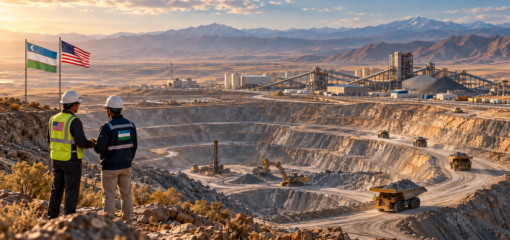
A central Uzbek challenge is to turn international interest in the country’s natural resources into lasting industrial development.
By Lord Waverley | [email protected]
US Secretary of State Marco Rubio’s forthcoming visit to Samarkand reflects a broader adjustment in American policy. He will attend the C5+1 ministerial with the foreign ministers of the five Central Asian states, leading a delegation of more than 200 American business leaders. Central Asia is increasingly being viewed through the lenses of economic security, access to strategic materials, transport infrastructure and regional stability, rather than primarily through its proximity to Afghanistan.
This shift creates opportunities for Uzbekistan and raises questions about the terms on which the country should engage with foreign investors. Competition over critical minerals has become an important element of international economic policy. Governments are seeking to diversify supply chains, particularly those associated with rare earth elements and other materials essential to advanced manufacturing.
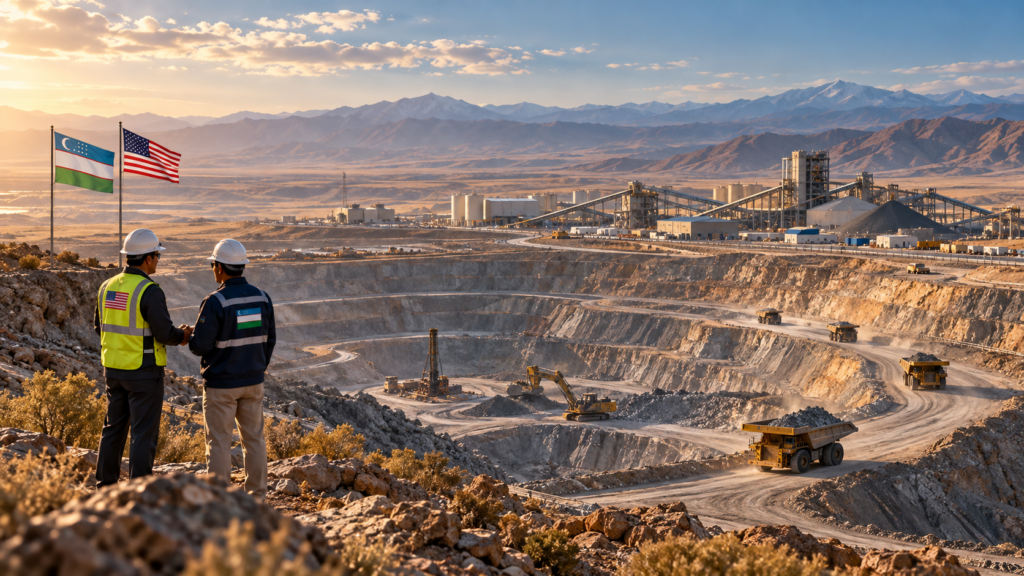
Washington’s interest in Uzbekistan fits within this effort to reduce exposure to concentrated processing networks and establish alternative sources of supply. It is not alone. The UK also treats critical minerals as a government priority. This month, during a visit to Tashkent led by the Minister of State for Trade, Lord Anas Sarwar, a 2026–2028 roadmap was signed with the Uzbekistan Technological Metals Complex (TMK), the state company at the centre of the sector. Its stated focus is high-technology production from tungsten, molybdenum, rhenium, lithium and rare earths.
From geological deposits to industrial capacity
In February, Uzbekistan’s Foreign Minister, Bakhtiyor Saidov, and US Deputy Secretary of State Christopher Landau signed a memorandum of understanding on securing supply in the mining and processing of critical minerals and rare earths. Its title is instructive: securing supply comes first. Rubio’s visit could help translate that framework into commercial projects.
Yet the presence of American companies, the signing of agreements and the announcement of large investment commitments will not, by themselves, demonstrate that the partnership is succeeding. The more important question is whether cooperation will strengthen Uzbekistan’s domestic productive capacity.
Countries that export unprocessed minerals generally capture only a limited share of the economic value generated by those resources. Extracting the material is only the beginning. For rare earths, the further stages can include chemical separation, purification, metal production, alloy manufacturing and the fabrication of permanent magnets used in electric vehicles, renewable energy systems, electronics and military technologies.
Each additional stage can generate specialised employment, technical knowledge and opportunities for domestic suppliers. If Uzbekistan remains confined to supplying raw materials, much of that value will be captured abroad. If it develops competitive processing and manufacturing capabilities, the benefits could extend well beyond the mining sector.
The objective, therefore, should not simply be to attract capital into mineral extraction. It should be to determine which parts of the production process can realistically be established within Uzbekistan, and how foreign investment can help develop them.
Why local processing is difficult to establish
Developing a mineral-processing industry is considerably more complicated than opening a mine. Established producers benefit from extensive industrial networks, experienced workforces, reliable infrastructure, specialised machinery and close links between manufacturers and research institutions.
China’s position in rare earth processing illustrates the importance of these advantages. Its competitiveness reflects decades of industrial development and the concentration of complementary capabilities within an established production system. Uzbekistan would need to build many of these foundations while competing against producers that already operate at scale.
The initial costs could be substantial. New facilities require dependable electricity, transport connections, water-management systems, environmental safeguards and workers with highly specialised skills. They may also face higher production costs until sufficient demand and operational experience are established.
Price competition presents another challenge. Even if a new Uzbek facility receives public assistance, it could struggle against established international producers with lower costs and more developed supply networks. If foreign competitors reduce prices sharply, the commercial viability of the new operation could deteriorate further.
This creates a dilemma for policymakers. Without targeted support, domestic processing may never become commercially viable. With poorly targeted support, Uzbekistan could end up financing inefficient facilities that survive only through repeated government assistance.
A successful strategy must therefore combine industrial ambition with commercial discipline. Public investment should help overcome clearly identified obstacles, but projects should also be evaluated against realistic demand, production costs, environmental requirements and prospects for long-term competitiveness.
The importance of accountable economic policy
Government participation will probably be necessary if Uzbekistan wants to move beyond the export of raw materials. Private investors typically prefer locations where infrastructure, suppliers and skilled workers are already available. Left entirely to market incentives, new processing operations may continue to concentrate in established industrial centres rather than in emerging producers. Public policy can help change that calculation through infrastructure development, vocational education, research partnerships, carefully structured financing and incentives for domestic production.
Yet large investment initiatives can also create opportunities for favouritism when companies compete for mining rights, tax concessions, subsidised credit or access to public infrastructure. Agreements negotiated rapidly during high-profile diplomatic visits may be particularly difficult to scrutinise if their financial and commercial terms are not adequately disclosed.
Uzbekistan should therefore treat institutional safeguards as part of its industrial strategy rather than as an administrative afterthought. Legislative scrutiny of major agreements and meaningful public accountability belong in that strategy. These protections matter to foreign investors too. Predictable regulation and transparent competition reduce uncertainty, strengthen confidence in the investment environment and make long-term industrial projects more attractive.
Negotiating a partnership that delivers more than supply security
The American delegation’s visit should give Uzbekistan an opportunity to clarify the substance of its proposed economic partnership with Washington. A central distinction must be made between agreements designed to secure access to mineral deposits and agreements intended to develop productive capabilities inside the country. The two objectives can overlap, but they are not identical.
A supply agreement might guarantee an American buyer access to Uzbek mineral output without requiring significant investment in local processing. Such an arrangement could generate export revenue and strengthen the buyer’s supply chain, but it would not create a substantial domestic industrial base. The first phase of the agreement signed in November 2025 between TMK and American Resources Corporation follows that pattern: Uzbek tungsten concentrate is to be refined in the United States.
An ambitious partnership could combine long-term purchasing commitments with investment in processing facilities, technical training, research cooperation and the development of Uzbek suppliers. Joint ventures could provide a mechanism for sharing expertise and commercial risks, and the US–Uzbekistan joint investment holding company proposed under February’s investment framework could serve as one. Cooperation between universities and laboratories could support the development of specialised skills.
The precise balance would depend on the mineral concerned, available infrastructure, expected demand and the economics of individual projects. The strongest case for deeper local processing lies in metals Uzbekistan already produces, notably tungsten and molybdenum, which Tashkent’s $4.2 billion critical minerals programme for 2026 to 2030 already targets. Rare earth magnets, where China’s lead is widest, are a longer-term ambition. The objective should be to identify the stages where local participation is economically defensible and to establish credible pathways for expanding that participation over time.
Uzbekistan should also consider how its relationships with multiple international partners can strengthen its negotiating position. Interest from the United States, the United Kingdom, the European Union and China gives Tashkent opportunities to compare investment proposals and seek better commercial and technological terms. On paper, London’s new roadmap leans towards processing inside the country; the tests set out below apply to it as fully as to any American proposal.
Nevertheless, competition between external powers does not automatically produce favourable outcomes for the host country. Its benefits depend on the quality of negotiations, the government’s ability to evaluate complex projects and the willingness of investors to make commitments that extend beyond resource procurement.
Excessively rigid localisation requirements could discourage investment or produce facilities that cannot survive without indefinite subsidies. Accepting proposals with few domestic obligations, on the other hand, could leave Uzbekistan with limited influence over the most profitable stages of production. The task is to encourage foreign capital while securing measurable contributions to domestic skills, technology and industrial development.
Five tests for investment proposals
Uzbekistan would benefit from assessing proposed projects against a set of strict criteria, judging them on their long-term contribution to the economy rather than on headline financial figures alone.
First, what proportion of production will take place inside the country? Investment announcements should distinguish clearly between mineral extraction, intermediate processing and the manufacture of finished or semi-finished products.
Second, what capabilities will remain after construction is complete? The presence of a foreign-owned facility is not sufficient if its most sophisticated operations, technical decisions and specialised services remain entirely overseas.
Third, how will domestic expertise develop? Agreements should specify opportunities for training Uzbek engineers, supporting scientific research and transferring practical knowledge to local businesses and institutions.
Fourth, can the project become commercially sustainable? Proposals should be assessed against realistic operating costs, market conditions, infrastructure requirements and the likely duration of any public assistance.
Fifth, how will the agreement be monitored? Transparent procurement, independent audits, disclosure requirements and clearly defined performance benchmarks can help ensure that public incentives correspond to genuine economic benefits.
A longer-term measure of success
Mining remains an important potential source of employment, tax revenue and export earnings, and foreign investment in extraction can provide the financial foundation for subsequent industrial development. The essential point is to connect resource development with a broader economic vision. Extraction should support diversification, not become a permanent substitute for it.
Rubio’s visit offers Tashkent a chance to demonstrate that it can attract international partners while pursuing its own development priorities. The strongest outcome would not necessarily be the largest announced investment or the greatest volume of minerals committed to export. It would be a set of commercially credible agreements that expand the country’s technical expertise, encourage domestic enterprise and lay the foundations for more sophisticated manufacturing.
Diplomatic visits generate attention, and signed agreements can signal political commitment. Neither guarantees lasting economic transformation.
Uzbekistan’s mineral wealth should be judged not only by the revenue it generates in the present, but by the economic capabilities it helps create. The strategic objective is to ensure that the country becomes more than a supplier of materials to other nations’ industries: it should develop the expertise, infrastructure and productive capacity to participate in those industries itself.
About the Author
Lord Waverley has a long record of engagement with Central Asia, including as chairman of the All-Party Parliamentary Group on Central Asia. He negotiated Memoranda of Understanding with each of the five parliaments of Central Asia. Lord Waverley has subsequently retired from the House of Lords.
Sources
- Spot.uz, “Marco Rubio to visit Samarkand with a delegation of more than 200 business leaders”, 14 October 2026. Accessed 15 October 2026.
- Ministry of Foreign Affairs of the Republic of Uzbekistan, news release on the Washington visit and memorandum, 5 February 2026. Accessed 15 October 2026.
- Uzbekistan Technological Metals Complex, “TMK and the United Kingdom take strategic cooperation on critical minerals to a new level”, 10 October 2026. Accessed 15 October 2026.
- American Resources Corporation, “American Resources Corporation and ReElement Technologies Forge Strategic Partnership with Republic of Uzbekistan to Advance Critical Mineral Supply Chain Beginning with Tungsten”, ACCESS Newswire, 10 November 2025. Accessed 15 October 2026.
- Stephen M. Bland, “Uzbekistan’s $4.2 Billion Critical Minerals Plan Aims to Turn Raw Materials Into Industry”, The Times of Central Asia, 17 June 2026. Accessed 15 October 2026.
Contributor opinion. Lord (JD) Waverley had no commercial relationship with CFI.co at the time of publication.
You may have an interest in also reading…

The Two-Tier Tariff: Washington Prices Labour Standards into Trade
The Section 301 action that took effect on 24 July prices a social standard into trade policy for the first
Cornelius Vanderbilt: The ‘Commodore’ Who Steamed Straight Ahead to Glory
In the annals of American corporate history, Cornelius Vanderbilt was a true legend: a self-made billionaire who rose from humble

Could Elon Musk Revolutionise Social Media by Acquiring TikTok?
The U.S. operations of TikTok face an uncertain future as the Supreme Court prepares to rule on a potential ban
