














































































Boards and AI: From Oversight to Insight
How AI can improve the effectiveness of boards
THE SHORT VERSION
AI is now supporting boards to do their work. Used well, it helps directors digest dense board packs, ask sharper questions, benchmark against peers and assess their own performance, freeing up valuable time for judgement based decision-making. This piece argues that the next phase of governance is not the governance of AI but governance with AI: AI should inform board decisions, not make them.
The purpose of boards has remained largely unchanged. Boards exist as oversight bodies: to ensure fair practices, protect shareholders and prevent malfeasance. What is changing is the means. Artificial intelligence (AI) now offers a better platform for the work boards have always done.

Author: Sunil (Sunny) A. Misser
For as long as boards have existed, they have operated at a structural disadvantage. Directors answer for a company they do not run, and most of what they learn reaches them through a single channel: the management team they are meant to oversee. Few teams set out to mislead, but the board pack is assembled by management, the framing is theirs, and it is often long enough that absorbing it fully before a meeting is a challenge in itself.
In practice, this means the board can end up seeing the company largely as management has chosen to present it, and that matters more than it once did. A director’s remit has stretched from financial performance, audit, legal and compliance to take in cybersecurity, geopolitical risk, climate-related financial risk, supply-chain integrity, human capital, regulatory divergence and reputational risk, all under a level of public scrutiny and personal liability that an earlier generation of directors never faced.
Used thoughtfully, AI can serve as a means of oversight in its own right. It allows directors to absorb more of the information they are given, frame sharper questions, and spend their time on judgement rather than on reading and retention. In other words, AI can support the board’s work, not merely sit on its agenda as a governance concern.
AI will not make the decisions. It leaves those who do better prepared and more capable of doing so. AI should inform, not decide.
How AI closes the board information gap
The clearest gain is the board pack. AI can work through a document running to several hundred pages, distil each section, point to what deserves attention and flag what is missing. It can also propose pointed questions against each agenda item, so directors arrive ready to get the answers they need.
It also supports independence. Rather than relying solely on management’s account, a director can ask AI to compare the company’s disclosures against peers, test the numbers against outside market data, and read across the board’s own back catalogue of materials for trends. PwC reports that 35% of directors say their boards have begun using AI and generative AI in their oversight work, from preparing for meetings to pressure-testing strategy. The result is a board that arrives with an informed view of its own.
Sharper preparation, better questions
AI can also take on administrative work: drafting minutes, carrying forward action items, logging attendance and keeping a record of which commitments were made and met. With less time lost to administration, directors can focus on what matters. The same tools can test a company’s performance measures against outside data, letting a board pressure-test a capital-allocation decision before the vote rather than explain it afterwards.
A mirror for the board: assessing its own performance
Boards have never found it easy to judge their own performance objectively. Working from agendas, committee charters and skills matrices, set against a wide body of peer disclosures and governance codes, AI can show directors where their time actually goes and how that compares with good practice elsewhere. That puts evidence behind the decisions most closely tied to long-term performance: how a board evaluates itself, its capacity and composition, and its current and future capabilities.
Can AI evaluate directors and management?
Today, directors are assessed largely by hand. That is beginning to change. A director’s record, including voting decisions, attendance and committee contributions, can increasingly be reviewed, analysed and benchmarked with the help of AI. The same approach can extend to management: CEO and executive decision-making can increasingly be assessed on a more continuous basis, and compared against peers, rather than only at quarterly intervals. Compensation and succession planning, today shaped heavily by judgement and relationships, can likewise be informed by more comprehensive analysis. None of this replaces the board’s judgement; it gives that judgement a firmer evidential base.
The evidence: AI-savvy boards and return on equity
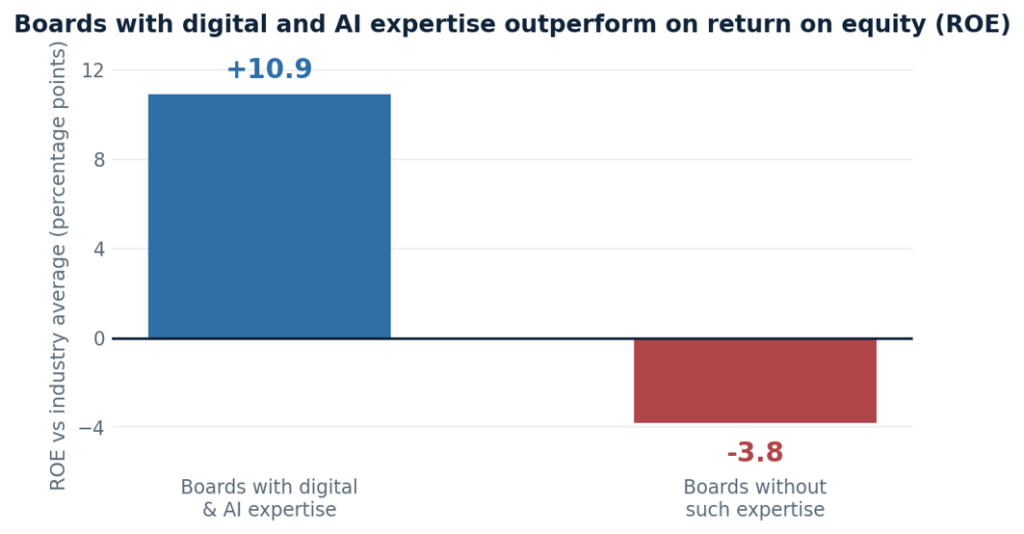
Figure 1: Companies with digital and AI expertise on their boards averaged a return on equity 10.9 percentage points above their industry, while those without averaged 3.8 points below. Chart: AccountAbility, derived from MIT Center for Information Systems Research, “Digitally Savvy Boards: AI Update,” 2025.
MIT’s Center for Information Systems Research reports that companies whose boards have digital and AI expertise sit 10.9 percentage points above their industry’s average return on equity, while those without it sit 3.8 percentage points below.
The figure measures the directors that comprise the board rather than how the board works: directors with digital and AI expertise, not the use of AI tools in its processes. While it is adjacent evidence rather than direct proof, nonetheless, it points in the same direction. Fluency with AI at board level travels with stronger performance, and boards with that fluency are best placed to put the tools described here to work.
Adoption, though, remains slow. McKinsey finds that only 39% of Fortune 100 companies disclose any form of board oversight of AI, and Deloitte’s global survey of directors finds that 66% say their boards have “limited to no knowledge or experience” with AI. The gap between the performance associated with AI-fluent boards and the readiness on the ground is precisely the opportunity.
The trade-offs are real
Using AI in the boardroom carries real responsibilities that need to be designed in from the start:
- AI outputs should always pass through human review before a board acts on them.
- Board materials are sensitive, so only company-approved tools and standardised systems should be used.
- Directors’ prompts and AI outputs can become part of the discoverable record, so retention rules should be agreed in advance.
The boards that are ahead of this will work to an agreed framework that sets out how and when AI tools are used, and phase their adoption over time. Used with sound, balanced judgement, AI is a valuable addition to the boardroom.
In the final analysis, AI will not make the decisions; it leaves those who do better prepared and more capable of doing so. That, in the end, is what board effectiveness has always meant.
Frequently asked questions
Can AI make board decisions?
No. The case here is for AI as a support tool, not a substitute: it should inform the board’s judgement, not replace it. AI helps directors prepare, question, and benchmark; the decisions remain theirs.
How can AI improve board effectiveness?
By closing the information gap. AI can summarise dense board packs, surface what is missing, draft pointed questions, compare a company against its peers, handle routine administrative tasks, and help a board assess its own performance, so directors can spend more time on judgement based decision-making.
Do AI-savvy boards perform better?
The data suggests so. MIT CISR found that companies with digitally and AI-savvy boards sat 10.9 percentage points above their industry’s average return on equity, while those without sat 3.8 points below (MIT CISR, 2025). The measure is expertise on the board rather than the board’s use of AI tools, so it shows fluency and performance moving together rather than proving cause.
How widely do boards use AI today?
AI adoption is in its early stages. PwC found 35% of directors say their boards have started using AI in their oversight work, while McKinsey found only 39% of Fortune 100 companies disclose any board oversight of AI, and Deloitte found 66% of boards report limited or no AI experience.
What are the risks of using AI in the boardroom?
Three core risks stand out: AI outputs need human review before they are relied on; sensitive board materials require company-approved, standardised tools; and because prompts and outputs may be discoverable, boards should agree on information retention rules, in advance.
Sources
- PwC, “Using AI in the Boardroom: New Opportunities and Challenges,” Harvard Law School Forum on Corporate Governance, 2025 (PwC 2025 Annual Corporate Directors Survey).
- MIT Center for Information Systems Research, “Digitally Savvy Boards: AI Update,” 2025.
- McKinsey & Company, “The AI Reckoning: How Boards Can Evolve,” 2025.
- Deloitte, “Governance of AI: A Critical Imperative for Today’s Boards” (2nd edition), Harvard Law School Forum on Corporate Governance, 2025.
By Sunil (Sunny) A. Misser Chief Executive Officer, AccountAbility
About AccountAbility
AccountAbility is an expert international sustainability advisory and standards firm that works with businesses, investors, governments and multilateral organisations to advance the global sustainability agenda by improving the practices, performance and impact of organisations. It operates globally from offices in New York, London, Riyadh and Dubai, supported by a highly qualified team recognised by the Financial Times, Forbes and Capital Finance International.
You may have an interest in also reading…

Crypto Had a Brutal Year. What Comes Next?
An increase in caution might not be a bad thing, believes the Kellogg School’s Sarit Markovich… The year since the

Blackstone’s Data Centre Push: When Private Capital Opens The AI Rails To Public Investors
As the AI boom shifts from model-building to infrastructure-building, data centres have become the new industrial real estate. Blackstone’s reported

Otaviano Canuto: Rising Use of Local Currencies for Cross-Border Payments
At the recent BRICS summit in Johannesburg, the leaders of Brazil, Russia, India, China and South Africa said they wanted
