









































































Synthetic Methane’s Opening Window for Investors and Policy Makers
Synthetic methane is moving from technical curiosity to investable relevance because it offers something rare in the transition: a lower-carbon molecule that can run through methane-native systems without forcing wholesale replacement of pipelines, storage, burners, turbines, and gas-linked industrial assets. The opportunity is therefore not only about decarbonisation. It is whether compatibility, policy signals, and falling renewable-power costs can create defensible economics in markets that still value the molecule.
A Compatibility Thesis, Not a Purity Test
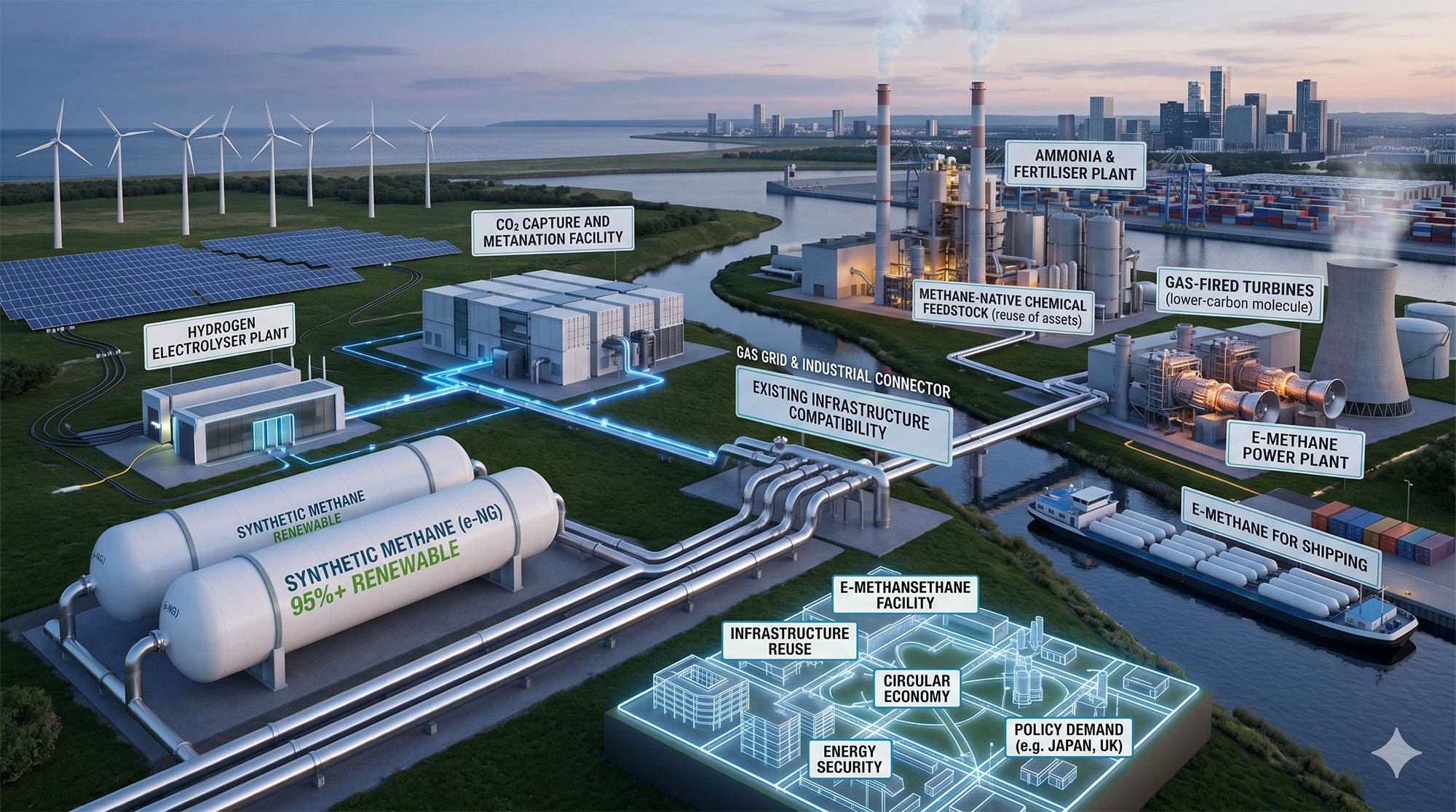
Synthetic methane, often described as e-methane, is produced by combining clean hydrogen with captured carbon dioxide. That production pathway matters less to investors than the deployment pathway. E-methane can serve existing gas infrastructure and methane-native industrial processes, which means the transition can be additive rather than a forced write-off of installed assets. That has implications for capital allocation because it shifts the question from ideal efficiency to usable economics in constrained sectors.
The e-methane project pipeline is no longer trivial. The e-NG Coalition’s project tracking indicates it is monitoring more than 150 projects globally, with announced production on course to reach about 1.3 million tonnes by 2031. The point is not that every project will reach scale. It is that the market has moved from a handful of demonstrations to a measurable investment pipeline.
Where Methane Still Has Economic Value
The investable question is not whether e-methane outperforms electrification or direct hydrogen on pure efficiency grounds. In many cases it does not. The question is narrower and more useful: where does the market continue to value methane itself enough for a lower-carbon substitute to earn attractive economics? Installed capital, feedstock constraints, storage needs, and security-of-supply concerns can make compatibility more valuable than theoretical system efficiency.
That framing avoids a false competition. Synthetic methane does not need to win every decarbonisation pathway to matter. It only needs to become the best answer in selected methane-native segments where switching friction is high and the molecule retains feedstock or resilience value.
Five Drivers Converging on E-Methane
Decarbonisation remains the baseline driver, particularly in sectors where direct electrification is still incomplete. Circular-economy value creation strengthens the case because captured carbon can be recirculated into productive use rather than treated only as waste. Infrastructure reuse is central, because pipelines, storage, combustion equipment, and gas-linked industrial systems do not have to be abandoned on day one. Energy security matters, especially for import-dependent economies where policymakers are under pressure to facilitate onshore solutions. Costs remain a thesis rather than a settled fact, but increasingly a testable one as renewable power prices fall and modular production scales.
On costs, investors should be disciplined. Competitive e-methane economics depend heavily on very low-cost clean electricity, reliable carbon sourcing, successful scale-up, and credible certification. Policy support may still be decisive in many markets. The relevant point is that cost is no longer a purely theoretical narrative, it is a trajectory that can be evaluated project by project, as illustrated by the project pipeline described by the e-NG Coalition.
Key Signals to Watch
| Signal | What It Suggests | Why It Matters | Source Anchor |
|---|---|---|---|
| 150-plus projects tracked; announced production of about 1.3 million tonnes by 2031 | Pipeline is moving beyond pilots; early scale-up ambition is emerging | Creates a measurable universe and a way to test delivered-cost economics | e-NG Coalition |
| Oil and gas dominate chemical feedstocks | Molecules still deliver feedstock value | E-methane can be more than fuel substitution | IEA, Chemicals |
| Just over 70 percent of ammonia made via natural-gas steam reforming | Ammonia is methane-native | Compatibility can be economically valuable | IEA, Ammonia Roadmap |
| Industrial heat pumps increasingly meet temperature needs up to 200°C | Electrification is extending into industrial heat | Sharpens where molecules remain valuable | IEA, Renewable Heat |
| Japan sets explicit injection and replacement ambitions for city gas | Policy can create demand visibility ahead of maturity | Supports bankability where infrastructure compatibility matters | METI methanation |
Circularity Where Molecules Still Matter
The circular-economy angle is central to the investment case because hydrocarbons still matter in several industrial value chains as both energy and feedstock. The IEA’s chemicals analysis notes that oil and gas remain the main feedstocks in the chemical sector because they provide hydrogen and carbon used to produce basic chemicals such as ethylene, propylene, and ammonia. In that context, synthetic methane offers more than a fuel swap. It reconnects renewable electricity, captured carbon, and existing gas-linked assets inside a productive loop.
For capital allocators, this is not circularity as branding. It is a route to extending the economic life of installed systems while lowering emissions intensity, provided that carbon sourcing and accounting rules are credible and durable.
Fertilisers and Ammonia as a Methane-Native Chain
Fertilisers and ammonia make the methane-native case unusually clear. The IEA’s Ammonia Technology Roadmap notes that just over 70 percent of global ammonia production is based on natural-gas steam reforming, leading to around 170 bcm of natural gas demand, about 20 percent of industrial natural gas demand. Ammonia is therefore not only exposed to gas prices; it is built around methane as feedstock.
For investors, that matters because it suggests e-methane could function as a lower-carbon substitute inside established chemical systems where plant design, feedstock logistics, and installed capital already anchor the process. The value is not only emissions reduction. It is compatibility inside a chain that is not easily re-plumbed overnight.
Industrial Heat and the Case for Segmented Winners
The industrial heat story points in the same direction. Electrified process heat is increasingly framed as a finance decision as much as a decarbonisation decision. CFI.co’s feature Heat Pumps That Pay argued that heat pumps can replace fuel volatility and carbon liability with a productive asset. The IEA similarly notes that industrial heat pumps are increasingly meeting temperature needs of up to 200°C, as set out in its discussion of renewable heat in Renewables 2025.
The implication for e-methane is not that electrification invalidates the theme, but that it sharpens it. Electrification increasingly wins where it is practical and efficient. Synthetic methane can remain valuable where high-temperature heat, long-duration storage, resilience, or molecule compatibility still matter. The likely market shape is therefore not winner-take-all, but segmented by use case.
Japan’s Policy Signal: Methanation Enters Mainstream Planning
Japan offers a clear signal that e-methane is being treated as a strategic option in an import-dependent market. METI’s public materials on methanation technology for carbon-neutral gas set out near-term targets such as injecting e-methane equal to 1 percent of city-gas supply by 2030, while broader policy materials describe an ambition for 2050 in which 90 percent of city gas is replaced by synthetic methane. The policy framing is expanded in the METI and IEA presentation on low-carbon gases.
Targets are not proof of economics. They are demand signals. For investors, that matters because policy ambition can create visibility and procurement pathways long before markets are fully mature, particularly in sectors where infrastructure compatibility reduces deployment friction.
UK Execution: Rivan and the Infrastructure Play
In the UK, early entrants are attempting to build around the infrastructure-compatibility thesis. Rivan describes itself as a vertically integrated synthetic fuel producer focused on industries that cannot easily electrify, with the aim of making synthetic fuel cheaper than fossil fuels over time. In April 2026, the company announced a £25 million funding round to scale synthetic fuel production, and disclosed a Wales & West Utilities partnership for a grid-connected synthetic natural gas project. Additional project context, including Little Rose Lane, is set out in Rivan’s Little Rose Lane project note.
For capital allocation, these early projects matter less as verdicts than as datapoints. They test whether the combination of clean power procurement, carbon sourcing, infrastructure access, and offtake structure can produce bankable economics in methane-native applications. Claims framed as “first” or “only” should be verified by the desk before publication because superlatives attract scrutiny.
Risks That Still Define the Investment Case
The risks remain substantial, even where the chemistry and infrastructure logic is credible. Many projects are pre-scale. Economics depend on very low-cost clean electricity, reliable carbon sourcing, successful system scale-up, and robust certification and accounting rules. Policy frameworks remain conditional in several markets, and Japan’s own materials link progress to cost reduction, mass production, and credible rules for recycled-carbon fuels, as reflected in the METI low-carbon gas strategy materials.
This leaves e-methane in the gap between technical credibility and full commercial proof. That gap is investable, but it demands selectivity.
A Specialist Theme With Real Optionality
Synthetic methane deserves attention now because it no longer needs to win the entire decarbonisation debate to matter. It is still early, still cost-sensitive, and still dependent on cheap clean power, credible carbon sourcing, and robust certification. Yet it has moved beyond the laboratory, and it targets segments where compatibility has real economic value.
For investors, the opportunity is likely to be selective rather than universal. Potential winners are those able to secure low-cost renewable electricity, reliable CO2 supply, infrastructure access, and policy-backed demand in methane-native markets. E-methane may not dominate industrial decarbonisation as a whole, but it could become dominant in selected sectors where methane retains the highest economic value. In a transition that often assumes replacement, the more durable opportunities can sometimes emerge from reuse.
You may have an interest in also reading…

Stablecoins Were Supposed to Bypass the Card Schemes. Instead, the Schemes are Positioning Themselves as the Operating System
Stablecoins emerged with a disruptive promise: move money instantly, globally and cheaply without relying on the banks, card schemes and

Otaviano Canuto: Politics and Climate Change Make Awkward Bedfellows in the Race to Tackle a Truly Fearsome Foe
The earth’s average surface temperature this May was higher than any other May on record… what can, and should, governments

Avatar Influencers are Storming Up the Earnings Charts — and Creators Stand to Make Some Healthy Profits
Virtual and AI personas have the highest earning potential for single Instagram posts… Digital personas created via AI or software
