













































































Bonus Season Goes Brick-and-Mortar: How Wall Street Pay Is Repricing US Property
Wall Street’s annual bonus cycle has long been a private ritual of conspicuous consumption. In 2025, it became something more consequential: a rolling liquidity event spilling into US property markets, from Hamptons trophy estates to workforce housing in fast-growing states. The sums are large, the signalling effects are immediate, and the strategic logic is shifting from luxury goods to durable assets.
The Hypothesis: Bonus Season as a Liquidity Event
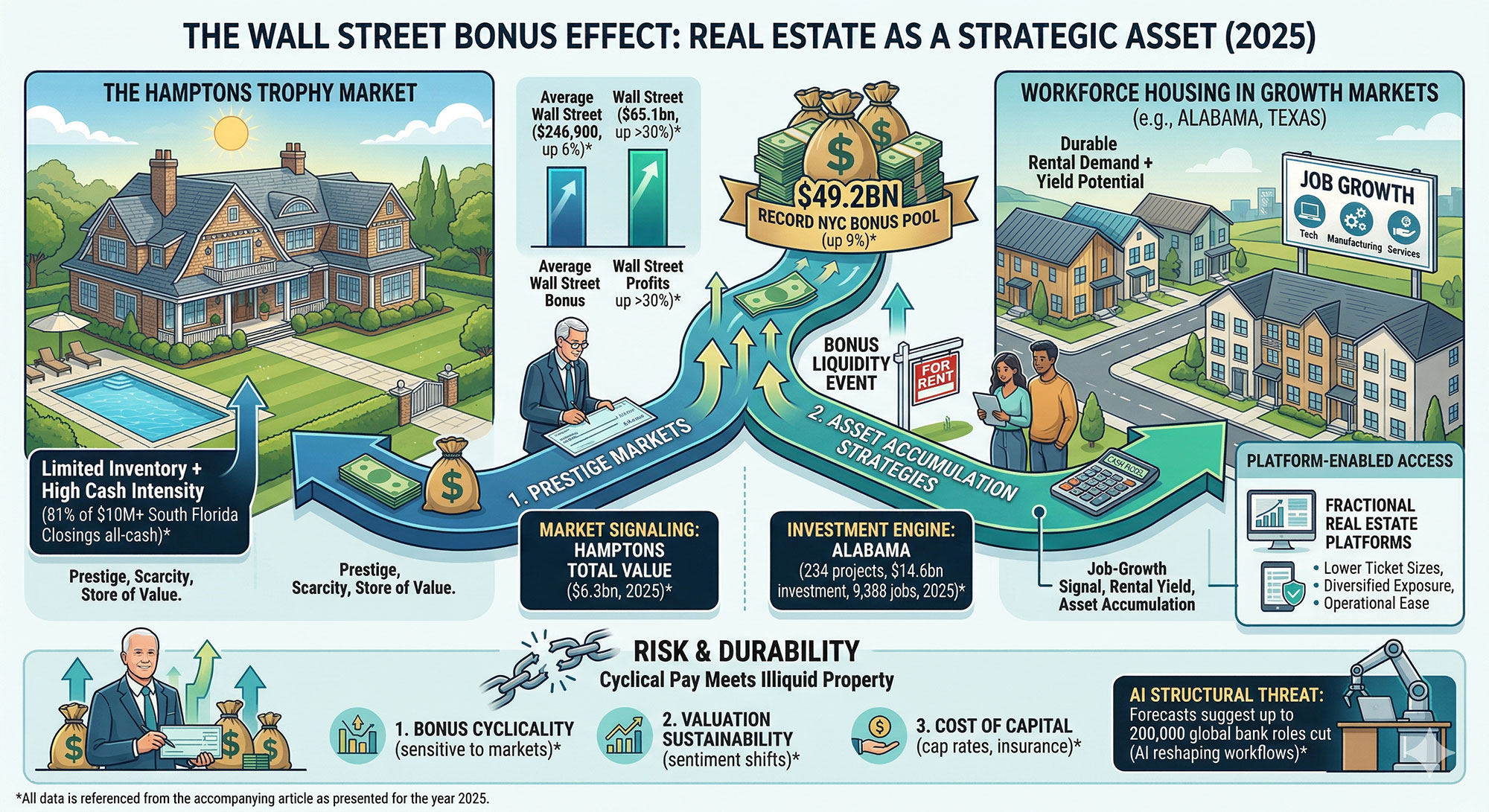
For most industries, compensation is a line item. For Wall Street, it can behave like a macro factor. Bonuses arrive in a concentrated window, creating a temporary surge in deployable liquidity and risk appetite. In 2025, that pulse was unusually pronounced. New York State Comptroller Thomas DiNapoli estimated a record $49.2bn bonus pool for New York City’s securities industry, up 9 percent year on year, with the average bonus rising 6 percent to $246,900, according to his office’s annual release.
This matters because bonuses do not simply reward performance, they redirect capital. When a meaningful share of a sector’s income is paid in one seasonal pulse, it behaves less like salary and more like a liquidity event. In 2025, that liquidity appears to have flowed into property, not only as lifestyle consumption but as a deliberate portfolio decision, one that treats real estate as a balance-sheet asset rather than a celebratory purchase.
The Channel: From Trading Profits to Property Demand
DiNapoli’s estimate ties the compensation surge to the operating environment. The same release notes that Wall Street profits rose more than 30 percent to $65.1bn in 2025, creating the conditions for higher bonuses and stronger state and city tax receipts. It is a reminder that volatility, when paired with rising markets, tends to be an ideal climate for trading desks, dealmakers and wealth managers, and that the resulting pay dynamics can spill beyond finance into asset markets that are far less liquid.
Key Numbers That Explain the Repricing Mechanism
| Indicator | 2025 Data Point | Primary Source |
|---|---|---|
| NYC Securities Industry Bonus Pool | $49.2bn (record), up 9 percent | Office of the NYS Comptroller |
| Average Wall Street Bonus | $246,900, up 6 percent | Office of the NYS Comptroller |
| Wall Street Profits | $65.1bn, up more than 30 percent | Office of the NYS Comptroller |
| Hamptons Total Dollar Value of Sales | $6.3bn (2025) | Mansion Global |
| South Florida $10m-Plus Closings | 361 closings (2025) | Realtor.com |
| Alabama New Investment and Job Commitments | $14.6bn and 9,388 job commitments (2025) | Office of the Governor of Alabama |
The New Status Asset
High-end property has always had a relationship with Wall Street money, but the mechanics are sharpening. In prestige markets such as the Hamptons, brokers have described intensified competition against a backdrop of limited inventory, with more buyers chasing a small pool of trophy listings. Market reporting suggests that demand at the top end was buoyed by the combination of rising equity markets and record payouts, and that the total dollar value of Hamptons sales reached $6.3bn in 2025, as detailed by Mansion Global, drawing on brokerage data and Douglas Elliman reporting.
For senior financiers, this is not merely discretionary consumption. Trophy property functions as a visible marker of arrival, but it is also privately rationalised as a store of value: tangible, psychologically reassuring, and often framed as more durable than fashion-led luxury goods in an era of shifting risk premia.
From Rolexes to Rental Yield
The more interesting story may be happening below the top tier. Observers have noted a behavioural shift among younger bankers and mid-level professionals: fewer signalling purchases, more asset accumulation. Watches and cars still have a place, but they do not offer the same combination of leverage, potential cash flow and perceived downside protection as property, particularly in markets where entry prices remain materially lower than coastal prestige zones.
This cohort is increasingly associated with workforce housing strategies: buying into markets supported by job creation and steady rental demand, rather than chasing status addresses. Texas, Florida, parts of the Midwest, and selected “Heartland” states recur in this narrative because they offer what expensive coastal markets often cannot: yield, a plausible growth story and more forgiving valuations.
Workforce Housing and the Job-Growth Signal
Alabama offers a clean example of the metrics that make workforce housing attractive to outside capital. Governor Kay Ivey’s office reported that the Alabama Department of Commerce annual report listed 234 projects in 2025 with a combined $14.6bn capital investment and 9,388 new job commitments, in its January 2026 announcement. Whatever the political framing, those numbers translate into housing demand and rental durability. For investors deploying bonuses into smaller-ticket properties, job growth is the demand engine that makes underwriting feel more like analysis than speculation.
The financing culture of Wall Street travels with this money. Even when cheques are smaller than those written for Hamptons estates, the underwriting mindset is familiar: cash-flow modelling, exit scenarios, and a willingness to structure partnerships. Informal syndications, co-investment arrangements, and small group vehicles can turn individual bonuses into larger purchasing power without requiring institutional scale.
Platform-Enabled Access and the Fractionalisation Trend
A parallel development is the growing visibility of platform-enabled access to property exposure. For investors who want the economics without operational burden, the appeal is obvious: smaller ticket sizes, diversified exposure, and a simpler route to participation. Whether these channels ultimately reduce risk or repackage it is an open question, but their growth reflects a broader reality: property is being treated as a mainstream capital-allocation decision rather than a side bet. For an illustration of the platform landscape, including the rise of fractional approaches, see a consumer-facing roundup such as Yahoo Finance’s overview of fractional real estate platforms.
Florida’s Compounding Advantage
If the Hamptons story is about prestige and scarcity, Florida’s story is about migration and compounding incentives. South Florida has increasingly been framed as a destination not just for leisure, but for finance itself, as hedge funds, private equity groups and asset managers expand their presence. The effect on housing is visible at the top end. Realtor.com, citing Miami Association of Realtors data, reports 361 closings in South Florida for homes priced at $10m or more in 2025, and also highlights a market structure characterised by high cash intensity. It notes that cash sales accounted for 40 percent of Miami closings in the referenced period, and that in the $10m-plus tier, 81 percent of closings were all-cash, as reported in its January 2026 coverage.
Cash-heavy demand matters because it can insulate prime assets from rate shock, even as the broader market cools. It also reinforces a core theme of this cycle: bonus liquidity does not merely increase purchasing power, it changes market microstructure by increasing the share of buyers who can transact without relying on marginal mortgage affordability.
The Risk Case: Pay Is Cyclical, Property Is Not
The bonus-to-property pipeline is not a one-way bet. It is sensitive to three factors: the durability of compensation, the sustainability of valuations, and the path of interest rates. Bonus pools rise and fall with market conditions. Property, once purchased, is illiquid and exposed to local cycles, insurance costs and regulatory constraints. The danger is most acute when a liquidity wave meets tight supply and optimistic price expectations, conditions that can turn rational allocation into momentum.
- Compensation durability. If capital markets activity cools, bonus pools compress quickly, and the marginal buyer disappears faster than housing supply can adjust.
- Valuation sustainability. Tight inventory and status dynamics can support prices for longer than fundamentals suggest, until sentiment shifts and liquidity thins.
- Cost of capital. Even cash-heavy segments are influenced by rates through cap rates, comparables, and the opportunity cost of holding illiquid assets.
The Structural Threat: AI and the Bonus Machine
There is also a deeper question embedded in the narrative: whether today’s compensation structure is as durable as it looks. Forecasts attributed to Bloomberg Intelligence have suggested that global banks could cut as many as 200,000 roles over the next three to five years as AI reshapes workflows, particularly in operational and entry-level functions, a risk discussed in Forbes’ coverage of the estimate. That is not a direct argument against property ownership. It is a challenge to the assumption that record bonus conditions are a permanent feature of the labour market.
The Annual Capital Event, Restated
The deeper lesson is that bonus season has started to function as an annual capital event. In 2025, it helped reprice select corners of US real estate, not through policy or stimulus, but through concentrated private liquidity. The winners are markets with constrained supply at the top end and markets with credible job growth and rental demand further down the curve.
Return to the hypothesis. When compensation arrives as a seasonal pulse, it behaves like investable liquidity. In 2025, that liquidity moved decisively into property. The caution is equally clear: when the labour market and the cost of capital reset, property does not adjust as quickly as a portfolio of liquid securities.
You may have an interest in also reading…

Power to the People — But Let’s Make it Clean and Renewable…
CFI.co meets the high-powered management team of Germany’s RENAIO Assets, experts in sustainability Oliver Platsch and Andreas Grassl had “had

Sango Capital: Reframing Africa’s Investment Landscape for a New Global Cycle
As global capital seeks diversified growth and risk-adjusted returns, Sango Capital reaffirms Africa’s position as a compelling frontier. From shifting

From Penetration to Inclusion: How CRC Credit Bureau Is Re-Engineering Nigeria’s Credit Ecosystem
Nigeria’s journey towards broad-based financial inclusion has accelerated markedly in recent years, with credit penetration emerging as one of the
