










































Prospects for Freer Exchange of China’s Currency
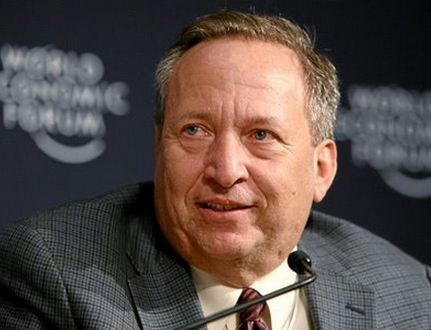
Lawrence Summers
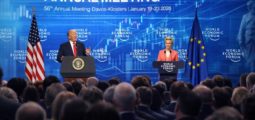
China’s currency, the renminbi (RMB), will probably not supplant the US dollar as the world’s reserve currency, except possibly “in the very long term”, said Lawrence H. Summers, Charles W. Eliot University Professor, Harvard University, and a former US Treasury Secretary, in a televised session at the World Economic Forum Annual Meeting on January 26th.
While the RMB will continue to internationalize, “the centrality of the dollar is unlikely to change in a major way,” Summers said, adding, “just as there is a basic inertia in languages of communication, there’s a basic inertia in mediums of exchange.”
John Zhao, the Chief Executive Officer, Hony Capital, however, expects freer exchange of the RMB “will come much sooner than most of us expect.” He cited the Chairman of China’s Communist Party Xi Jinping’s recent trip to Shenzhen, during which he visited Qianhai, a special zone set up for experimentation in RMB internationalization, as a sign of China’s intent to globalize its currency.
“the centrality of the dollar is unlikely to change in a major way”
– Lawrence Summers
Summer also spoke of “the reality that China holds some trillions of dollars of liquid financial assets around the world, on which it is earning an extremely low rate of return, while at the same time there are important shortages of investments in key sectors of the world”. Huge amounts of capital flowing from poorer countries to richer countries is “unprecedented territory”, he said, and will require important deliberations.
The panellists discussed how an ascendant China needs to communicate its intentions to the world. China’s world power status arrived decades earlier than expected. “It has been a bigger surprise to China than probably to the rest of the world,” said Kevin Rudd, Member of Parliament, Australia, and a former prime minister of that country. He cited a speech given by Xi, in which he spoke of China’s “rejuvenation”, and the lack of clarity of what that means. China has benefitted from an international rules-based order; the international community “would like to know soon if [China] would like to make changes to the rules,” he said.
Gordon Brown, the UN Special Envoy for Global Education, and Prime Minister of the United Kingdom (2007-2010), said that the rise of China is taking place in an interconnected world, a “totally different context than any other power in any other century”. He urged international communication among China and other countries.
China needs to develop a global agenda, said Zhao, “and learn very quickly how to play a good citizenship role in the new order which is being formed.” He cited two “certainties” in the world: politics is national and economics is global; the challenge countries face is to reconcile the two.
Communication and a redirection of focus are key. “We spent the last half-century trying to understand Washington,” said Rudd. Now it’s time to study and learn “how Beijing sees the world.”
You may have an interest in also reading…
The Midas Touch, or Not So Much? The Mythical Metal vs Shares
Gold is the age-old standard that once underpinned our modern currencies; what value does it have in physical form? In
Hydro, Hydro, and Off to Work Go Your Euros — RENAIO has its Game Plan All Worked Out
Unique combination of technology and sustainable asset management. Hydropower is key to accelerating and diversifying the global energy transition —
Finance Expert Knows Which Questions To Ask — And Where to Find Answers
A banker, a businessman … and a trained military interrogator? Meet Jakob Lindquist. CORDET managing member Jakob Lindquist founded the
