











































































2025: When Markets Made Renewables Dispatchable
For years, the energy transition was argued as much on ideology as on engineering. Supporters framed renewables as a moral imperative; critics framed them as an expensive, unreliable add-on that would always need a parallel fleet of fossil backup.
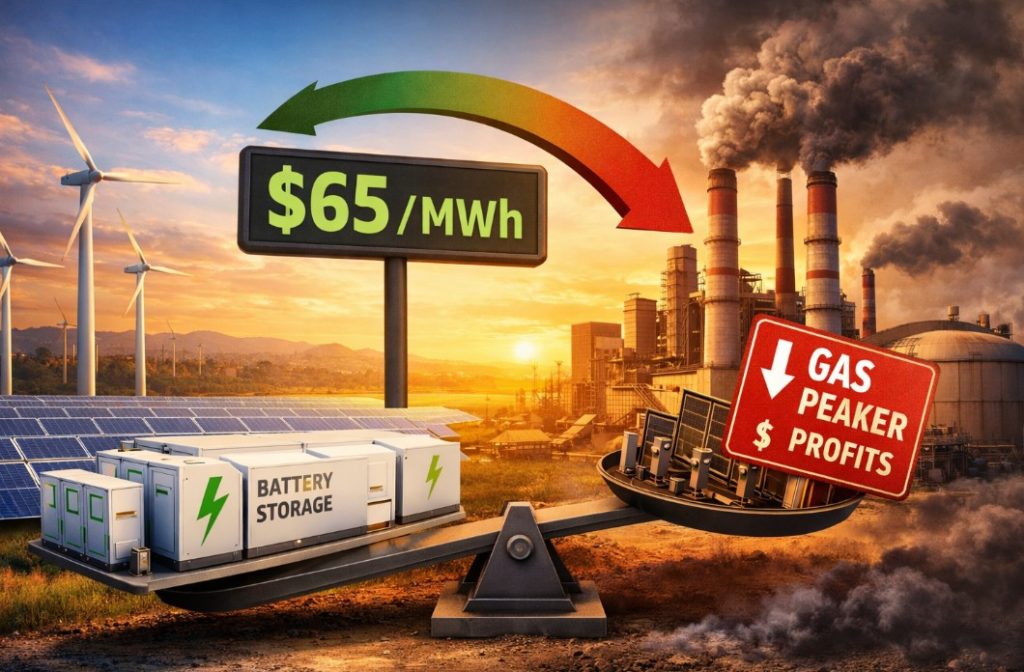
In 2025, the argument shifted. Not because politics softened, but because the economics did. Battery storage crossed a cost threshold that turns low-cost solar and wind into dependable capacity in more markets and more hours of the day. Once that happens, the role of gas peakers – and even the notion of gas as a long-term ‘bridge’ – starts to look less like prudence and more like a legacy assumption.
The Tipping Point: Storage at $65/MWh
Late in 2025, Ember published auction-based analysis showing a levelised cost of storage (LCOS) of about $65/MWh for utility-scale battery projects in markets outside China and the United States (as of October 2025). At the same time, it estimated an all-in, grid-connected system cost of roughly $125/kWh for four-hour (and longer) projects in those markets.
This matters less as a headline number than as a practical consequence: storage is no longer ‘premium’ infrastructure reserved for demonstration projects. At these levels, batteries can arbitrage the solar curve at scale – charging when energy is abundant and cheap, and discharging into evening peaks – and still clear competitive returns under auctioned contracts.
From Scarcity Rent to Squeezed Margins
Gas peakers were built for exactly those evening peaks. Their business model relies on scarcity: a relatively small number of operating hours, offset by high prices when the system is tight. Cheap storage attacks that scarcity directly. As batteries take peak-shaving duty, the spread between off-peak and peak prices compresses, and the revenue spikes peakers need to earn back capital become less frequent and less extreme.
For utility CFOs and infrastructure investors, the result is not merely ‘more competition’ – it is a change in asset character. A peaker valued as a predictable, yield-like cashflow stream starts to look like a volatile option whose premium is being competed away.
Proof on the Grid: California’s Evening Peak
The clearest place to watch this play out is California. According to the U.S. Energy Information Administration (EIA), electricity generation in California from January through August 2025 was 140.9 billion kilowatt-hours (BkWh). Utility-scale solar produced 40.3 BkWh over that period – nearly double the 22.0 BkWh recorded in the same period of 2020.
Over the same January-August window, natural gas supplied 45.5 BkWh, around 18% less than in 2020. The shift is most visible in the net-peak hours: EIA data show batteries discharging an average of 4.9 GW between 5 p.m. and 9 p.m. in May and June 2025, displacing gas during the hours it historically dominated. (CAISO changed its natural-gas data collection methodology in December 2023, which affects some older hourly comparisons; EIA flags this in its note.)
California is not ‘typical’, but it is instructive. Once storage is deployed at meaningful scale, it changes the dispatch stack, not just the emissions profile. It converts surplus midday solar into a resource that can perform during the system’s most valuable hours.
The Long Game: Multi-day Storage and the Dunkelflaute
Lithium-ion batteries are strong at shifting energy across hours. The harder problem is multi-day and seasonal reliability – the sort of weather-driven lulls often described in Europe as a ‘Dunkelflaute’ (a period of low wind and low solar). That challenge has been the last refuge of the argument that fossil plants must remain the default provider of firm capacity.
In 2025, long-duration energy storage (LDES) moved from promise toward credible project pipelines. Form Energy’s iron-air technology is a leading example: in Maine, an 85 MW / 8,500 MWh multi-day storage project has been advanced under the ‘Power Up New England’ initiative, supported by a federal grant. The significance is not that a single project solves resource adequacy, but that multi-day storage is becoming an investable category rather than a science project.
LDES will not eliminate the need for firm capacity everywhere. Transmission constraints, hydrology, and extreme demand events still matter. But once multi-day storage is bankable and repeatable, it reduces the amount of fossil ‘insurance’ a system needs to carry – and it does so with assets that can be sited and built far faster than new thermal plants.
Supply-chain Realism: Sodium as a Hedge
2025 also brought a more practical conversation about supply chains. Institutional capital has become wary of concentrating the storage build-out in a narrow set of minerals and processing geographies. That has created room for alternative chemistries where the value proposition is less about being ‘better than lithium’ and more about being ‘good enough’ at lower cost and with different inputs.
Sodium-ion is emerging as one such hedge. In late 2025, Peak Energy announced a phased agreement to supply up to 4.75 GWh of sodium-ion systems to Jupiter Power for deployments between 2027 and 2030. Deals of that scale signal a willingness to diversify technology risk, and they underscore that storage is becoming an infrastructure class with multiple viable supply routes.
The Capital Shift: Follow the Money
When solar, wind and storage are not just cheap energy but reliable capacity, capital begins to behave differently. The transition moves from a ‘push’ phase – driven by subsidies, mandates and ESG pressure – to a ‘pull’ phase driven by cost of service and bankable reliability.
The International Energy Agency’s World Energy Investment 2025 outlook estimates total energy investment reaching around $3.3 trillion in 2025, with roughly $2.2 trillion directed to renewables, nuclear, grids, storage, low-emissions fuels, efficiency and electrification. The same outlook highlights rapid growth in storage investment over the past decade, with battery storage investment expected to reach the tens of billions of dollars in 2025.
At the same time, the cost of capital for new fossil projects is rising. Lenders and equity investors increasingly price transition risk into thermal cashflows: if storage keeps falling in cost, a new peaker may be undercut before it has repaid its debt. In that world, the relevant question is not whether gas can still run – it is whether new-build gas can still underwrite.
Conclusion: The End of the ‘Bridge’ as Default
Natural gas will not vanish overnight. But 2025 made one thing clearer: in more jurisdictions, the cheapest path to reliability is becoming a portfolio of wind, solar and storage, rather than renewables plus a growing set of fossil backups.
For investors, the message is straightforward. Storage has crossed from ‘adjacent’ to ‘structural’. Portfolios predicated on the longevity of scarcity-priced peaking assets are fighting the tape. The next decade of power-system returns is likely to accrue to flexible assets that can store, shift and firm clean generation – and to the networks that connect them.
Sources
- Ember (as reported by Electrek, 12 Dec 2025): analysis of LCOS (~$65/MWh) and system costs (~$125/kWh) as of October 2025.
- S. Energy Information Administration (EIA), Today in Energy (24 Nov 2025): ‘Natural gas use for electricity in California falls as solar generation rises’ (Jan-Aug 2025 generation, solar growth, gas decline; evening battery discharge averages).
- Governor of Maine / Office of Governor Janet Mills (16 Aug 2024): ‘Power Up New England’ announcement including Form Energy’s 85 MW / 8,500 MWh iron-air project and federal grant support.
- Peak Energy (12 Nov 2025): ‘Peak Energy Signs 4.75 GWh Contract with Jupiter Power’ (phased delivery 2027-2030).
- International Energy Agency (IEA), World Energy Investment 2025 (executive summary and report): 2025 total energy investment and storage investment trendlines.
- Lazard, Levelized Cost of Energy+ (June 2025): comparative ranges for new-build generation and storage economics (context for peakers vs renewables-plus-storage).
You may have an interest in also reading…

Otaviano Canuto, IMF: China’s Spill-Overs on Latin America and the Caribbean
The Chinese economy is rebalancing while softening its growth pace. China’s spillovers on the global economy have operated through trade,

US Investment Analysts Have Moved On from Trump
Wall Street doesn’t believe in miracles. In anticipation of a ‘blue wave’, US investors pushed the blue-chip S&P 500 up

PJ O’Rourke: One of the Last of the Gonzo Journalists
A gonzo-style journalist par excellence, PJ O’Rourke will seldom fail to tackle serious societal issues with sarcastic humour and some
