










































































Ten Recent Technology Advances That Asset Allocators Should Have on the Radar
A CFI.co briefing on the engineering breakthroughs, grid innovations and early deployments that are compressing cost curves and reshaping the risk–return map for energy and infrastructure investors.
For much of the past decade, the energy transition debate was framed as a contest between policy ambition and political reality. Over the past 12 months, that framing has become less useful for capital allocators. The binding constraints are increasingly practical: how quickly grids can connect new capacity, how reliably inverter-based systems can operate at scale, and how fast storage and electrified heat can displace fossil flexibility, all while keeping system costs bankable and politically durable.
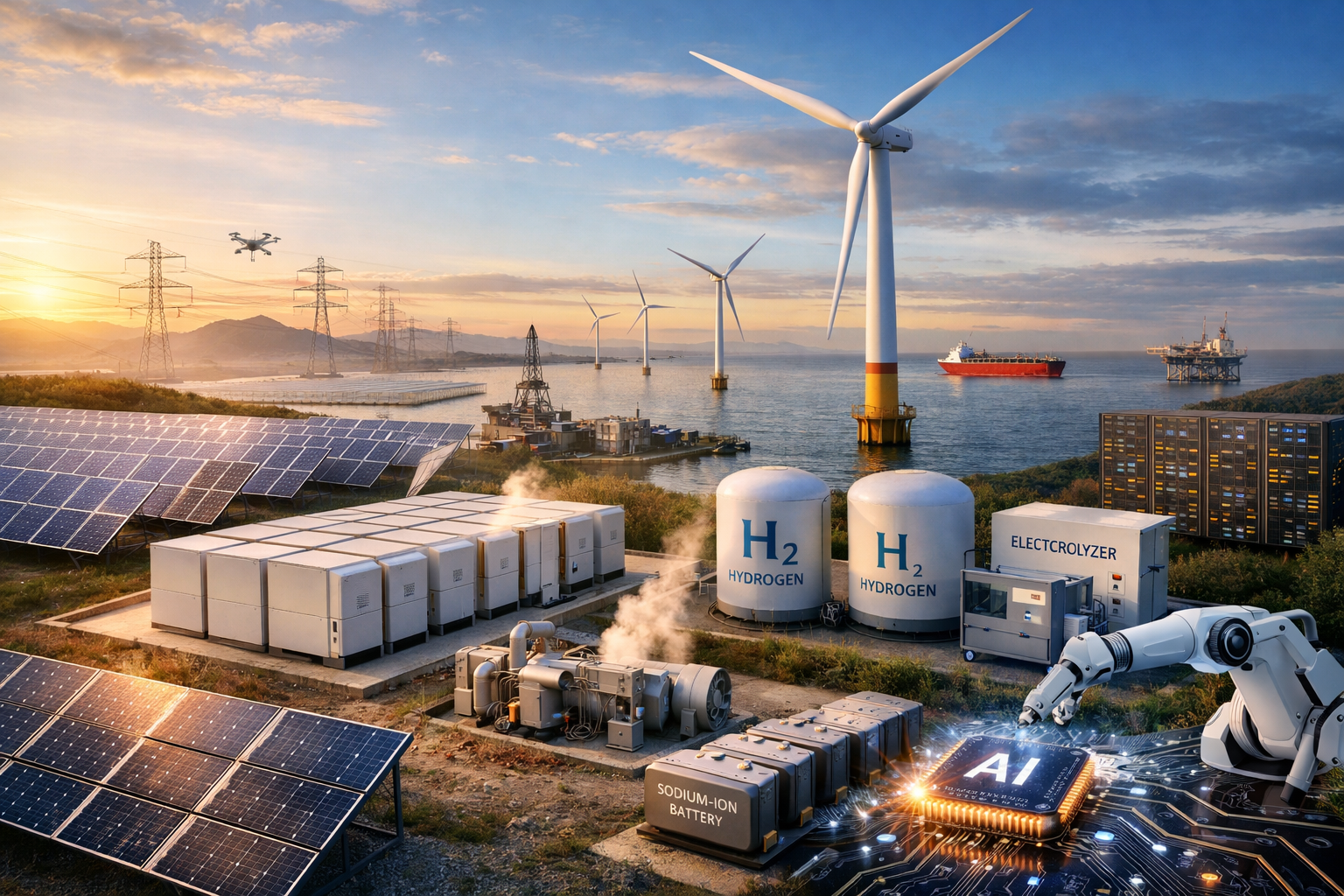
Three signals stand out. First, the technology learning curve remains steep, particularly in photovoltaics and batteries, with world-record efficiencies continuing to rise and alternative chemistries moving into operational pilots. Second, hard infrastructure is catching up. Grid-forming controls and grid-enhancing technologies are shifting from pilots into procurement decisions and code updates, directly influencing interconnection queues, curtailment risk and capacity factors. Third, large buyers, including hyperscalers, are underwriting clean-firm solutions in ways that can accelerate bankability and bring lender comfort forward by years.
It is not accidental that the journal Science named the renewable energy surge its 2025 Breakthrough of the Year. The accolade reflects not a single laboratory milestone but compounding improvements across manufacturing scale, deployment discipline and system integration.
Key Takeaways for Allocators
Cost curves continue to steepen, but bottlenecks are shifting from generation technology to grids, permitting and firming capacity. Storage is diversifying, with sodium-ion and iron-air moving from narrative to procurement and operational pilots. Electrifying heat is becoming investable, as steam-producing and above-200°C-class heat pumps enter industrial settings. Clean firm power is broadening beyond gas-plus-offset models, with enhanced geothermal scaling in both project ambition and financing. Artificial intelligence is emerging as both a demand shock, through data centres, and a productivity multiplier, optimising systems and accelerating materials discovery.
The Ten Advances
1. Perovskite–Silicon Tandems and Next-Generation Silicon Push PV Efficiency to New Records
What’s new: In April 2025, LONGi reported an NREL-certified 34.85 percent two-terminal perovskite–silicon tandem cell efficiency, a new world record for this architecture. In the same month, it also reported a 27.81 percent hybrid interdigitated-back-contact crystalline silicon cell efficiency, certified by ISFH.
Why it matters: Cell efficiencies do not translate one-for-one into immediate module-level gains, but they signal that the dominant generation technology still has meaningful headroom. Incremental efficiency improvements can reduce balance-of-system costs such as land, racking, cabling and labour, particularly in grid- or space-constrained markets. For projects competing for scarce interconnection capacity, higher yield per square metre can materially affect returns.
Allocator angle: Durable advantage is likely to accrue to manufacturers with defensible process know-how, equipment suppliers enabling higher-throughput deposition and quality control, and developers able to monetise marginal efficiency gains in constrained markets. The implication is less about a single record and more about sustained learning rates.
2. Sodium-Ion Batteries Cross Key Commercial Thresholds in Safety and Deployment
What’s new: In September 2025, CATL’s sodium-ion Naxtra battery passed China’s GB 38031-2025 traction battery safety requirements. In February 2026, CATL and CHANGAN unveiled what they describe as the first mass-production passenger vehicle equipped with sodium-ion batteries, targeting market launch in mid-2026. In the US, Peak Energy delivered and energised a 3.5 MWh sodium-ion system at SolarTAC in Colorado, among the first grid-scale operational pilots of the chemistry in North America.
Why it matters: Sodium-ion reduces exposure to lithium market volatility and critical mineral constraints. For stationary storage, where weight and volume are less critical than cost, safety and cycle life, the chemistry offers practical advantages. The investable implication is optionality. A second mainstream chemistry broadens the addressable supply chain and may ease bottlenecks that otherwise slow deployment.
Allocator angle: Early winners may include system integrators and developers building diversified storage portfolios, alongside manufacturers and component suppliers positioned for non-lithium chemistries. Portfolio diversification at the chemistry level can translate into resilience at the asset level.
3. Multi-Day Storage Turns a Corner as Hyperscalers Underwrite Iron-Air at Unprecedented Scale
What’s new: In late February 2026, Google and utility Xcel Energy announced an agreement that includes a 300 MW / 30 GWh iron-air battery system supplied by Form Energy, paired with new wind and solar capacity to support 24/7 carbon-free electricity ambitions.
Why it matters: Long-duration storage remains one of the hardest missing pieces in high-renewables grids. A marquee buyer moving a multi-day solution from pilot stage into flagship procurement can accelerate standardised contracting, insurance frameworks and lender familiarity. Roughly 100-hour storage shifts the conversation from intraday balancing to multi-day resilience.
Allocator angle: Watch for platforms combining short-duration lithium systems with multi-day technologies, and for the enabling ecosystem around civil works, controls integration, interconnection engineering and performance guarantees. Bankability often rests as much on delivery capability as on chemistry.
4. Enhanced Geothermal Moves from Promise to Pipeline: Bigger Projects, Clearer Timelines, Hotter Wells
What’s new: In June 2025, Fervo announced financing to accelerate its Cape Station development in Utah, comprising Phase I of 100 MW targeting first power in 2026 and Phase II adding 400 MW by 2028. In February 2026, the company reported resource temperatures exceeding 555°F at a new Utah site following appraisal drilling.
Why it matters: If next-generation geothermal can industrialise drilling and completion techniques, it offers rare attributes in a decarbonising system: clean, firm capacity with high utilisation. That combination is valuable for capacity adequacy, grid stability and for buyers seeking around-the-clock clean energy rather than intermittent certificates.
Allocator angle: Focus on repeatability. Drilling cadence, well performance distributions, offtake structures that appropriately value firmness, and depth in rigs, services and subsurface modelling will determine whether geothermal evolves from bespoke projects to scalable platforms.
5. Industrial Heat Pumps Reach Steam and >200°C-Class Territory
What’s new: In February 2026, Turboden announced start-up of what it describes as the world’s largest steam-producing heat pump, delivering 12 MWth of superheated steam using low-grade waste heat and CO₂-free electricity. Research reported in late 2025 highlighted thermoacoustic Stirling heat pump prototypes capable of supply temperatures above 200°C.
Why it matters: Heat accounts for a large share of final energy demand, and industrial steam is a major decarbonisation challenge. High-temperature heat pumps may prove more efficient than hydrogen in many applications, while creating flexible electric demand that can shift to periods of high renewable output.
Allocator angle: Investable exposure spans equipment manufacturers, industrial efficiency project developers and infrastructure funds financing energy-as-a-service retrofits with contracted savings. Electrified heat is moving from theory into asset-backed opportunity.
6. Solid-State Batteries Move into Higher-Capacity Prototype Shipments from Automated Lines
What’s new: In December 2025, UK-listed Ilika reported shipping 10 Ah Goliath solid-state battery prototypes manufactured on an automated pilot line completed in October 2025, citing a 93 percent manufacturing success rate for the first batch.
Why it matters: Solid-state batteries remain early for mass-market electric vehicles, but 10 Ah-class shipments mark progress beyond coin-cell demonstrations. They enter the qualification regime where automotive and industrial customers can test performance, safety and manufacturability at more relevant scales.
Allocator angle: This remains venture-style optionality. Exposure may be more attractive through specialist funds or through enabling materials and process tooling providers, rather than assuming rapid displacement of incumbent lithium-ion technologies.
7. Grid-Forming Controls and Grid-Enhancing Hardware Shift from Pilots to System Requirements
What’s new: In March 2025, Great Britain connected what the National Energy System Operator described as its first grid-forming battery site in Scotland under the Stability Pathfinder programme. In November 2025, ENTSO-E published a Phase II technical report underpinning grid-forming requirements for non-synchronous generation and storage within the draft Network Code on Requirements for Generators. In parallel, the US Department of Energy has highlighted grid-enhancing technologies such as dynamic line rating and power-flow control devices as near-term options for unlocking capacity on existing lines.
Why it matters: As inverter-based resources dominate new build, stability and congestion become the rate limit on deployment. Grid-forming capability increases resilience in low-inertia systems, while grid-enhancing technologies can deliver capacity gains without waiting a decade for new transmission corridors.
Allocator angle: This is a capital deployment theme. Power electronics, advanced controls software, reconductoring, transmission retrofits and regulated utility capex programmes with defined returns may form the backbone of risk-adjusted exposure.
8. Offshore Wind Turbines Keep Scaling: Prototypes and Test Installations Push Beyond 20 MW
What’s new: In 2025, Siemens Gamesa completed work on a 21.5 MW prototype at the Østerild test centre in Denmark. In August 2025, China’s SASAC reported installation of a 26 MW offshore wind turbine for testing at the Dongying base. Industry forecasts continue to project substantial growth, with GWEC anticipating 350 GW of new offshore capacity over 2025–2034.
Why it matters: Larger turbines can reduce foundations, array cables and operations and maintenance events per gigawatt, improving project economics. Yet scaling also increases execution risk across supply chains, installation vessels and financing structures.
Allocator angle: Focus on differentiated segments such as subsea cables, installation logistics, condition monitoring and portfolios with contracted revenues that appropriately price construction and merchant risk.
9. Green Hydrogen: Iridium-Thrifty PEM Catalysts and Recycling Strategies Improve Scalability Maths
What’s new: In October 2025, Rice University reported a PEM electrolyser catalyst approach reducing iridium use by more than 80 percent while maintaining performance in an industrially relevant cell. Research commentary in 2026 increasingly emphasised integrated iridium management combining higher utilisation, component design and closed-loop recycling.
Why it matters: Hydrogen’s investment case hinges on capex, utilisation and critical material supply. Reducing and recovering iridium is central to scaling PEM electrolysers beyond niche deployment without encountering hard resource limits.
Allocator angle: Exposure may be more compelling in enabling layers such as catalyst supply, recycling and balance-of-plant equipment, and in projects with credible offtake and high utilisation rather than speculative hubs without anchored demand.
10. Floating Solar Becomes More Bankable as Yield, Reliability and O&M Assumptions Are Formalised
What’s new: In April 2025, the IEA PVPS Task 13 programme published an executive summary reviewing energy yield, reliability and maintenance considerations for floating photovoltaic plants, reflecting growing attention to operational performance and de-risking.
Why it matters: Floating solar is not universal, but in land-constrained regions it can unlock additional capacity where permitting and site availability are tight. For financiers, the central question is risk modelling, including mooring integrity, corrosion management, maintenance access, yield uncertainty and insurance treatment.
Allocator angle: Look for developers with repeatable designs and strong counterparties, and consider floating solar within hybrid projects where grid connection is the scarce asset.
Conclusion: The AI Multiplier and the Risk of Stranded Fossil Flexibility
The past 12 months show an energy system in which engineering iteration is compounding: higher-efficiency photovoltaics, diversifying batteries, credible clean-firm options and more capable grids. No single breakthrough resolves decarbonisation. Instead, the system’s cost and performance frontier is moving in measurable increments through certifications, pilots and procurement.
Artificial intelligence is likely to accelerate that frontier in two directions. First, it is already being deployed to optimise energy systems, reduce costs and improve efficiency, even as it drives new electricity demand from data centres. Second, AI-assisted materials discovery is shortening development cycles in batteries and photovoltaics, tightening feedback loops between scientific insight and industrial engineering.
If those gains translate into faster learning rates, cost curves for clean generation, storage and electrified heat may steepen further. Fossil fuel solutions then face pressure not only from regulation but from economics. As renewable generation continues to draw on free primary inputs such as sun and wind, and as storage becomes cheaper and more diverse, fossil flexibility is squeezed on operating economics and challenged on system role by better controls and firming technologies.
For asset allocators, fossil exposure may resemble an option with rising tail risk, sensitive to technological breakthroughs, system design choices and the pace at which grids absorb new capacity. By contrast, the enabling layers grids, power electronics, diversified storage and industrial electrification appear increasingly central to the capital-absorbing backbone of the next decade’s energy build-out.
Sources and Further Reading
- Science (2025 Breakthrough of the Year): “Good morning, sunshine” (renewable energy surge)
- LONGi: 34.85% two-terminal crystalline silicon–perovskite tandem solar cell (NREL certified)
- pv magazine: Longi achieves 34.85% efficiency for two-terminal tandem perovskite solar cell
- LONGi: 27.81% HIBC monocrystalline silicon solar cell (ISFH certified)
- pv magazine: Longi claims world’s highest efficiency for silicon solar cells (27.81%)
- CATL: Naxtra battery passes GB 38031-2025 traction battery safety requirements (Sept 2025)
- CATL & CHANGAN: world’s first mass-production sodium-ion passenger vehicle unveiled (5 Feb 2026)
- Peak Energy: first grid-scale sodium-ion battery storage system in the US (company release)
- Utility Dive: Peak Energy deal marks progress for sodium-ion batteries in US (context on pilot)
- pv magazine USA: Google to deploy 300 MW / 30 GWh iron-air battery for Minnesota data centre
- Canary Media: Gigantic Form Energy battery to power Google data centre in Minnesota
- Fervo Energy: $206m financing to accelerate Cape Station (100 MW in 2026; +400 MW by 2028)
- Fervo Energy: Project Blanford appraisal drilling confirms >555°F resource (Feb 2026)
- pv magazine: world’s largest steam-producing heat pump comes online in Finland (12 MWth)
- AIP Publishing (Applied Physics Letters): ultra-high-temperature thermoacoustic Stirling heat pump prototype (>200°C)
- pv magazine: Chinese scientists unveil thermoacoustic ultra-high temperature heat pump prototype (Dec 2025)
- Ilika: ships 10 Ah Goliath solid-state battery prototypes (Dec 2025)
- NESO: Great Britain’s first grid-forming battery connects in Scotland (11 Mar 2025)
- ENTSO-E: Phase II technical report on grid-forming requirements (4 Nov 2025)
- US DOE: Grid-enhancing technologies (dynamic line rating, power-flow control devices, etc.)
- POWER Magazine: Siemens Gamesa installs 21.5 MW prototype turbine at Østerild test site
- SASAC (China): installation of 26 MW offshore wind turbine for testing (Sept 2025 report)
- GWEC: offshore wind capacity forecast (350 GW added 2025–2034; 441 GW total by end-2034)
- IEA PVPS Task 13 (Executive Summary): floating PV plants — yield, reliability and maintenance (Apr 2025)
- Rice University: catalyst cuts iridium use by 80% for PEM electrolysers (Oct 2025)
- Chem Catalysis (Cell Press): ‘Iridium management strategies for scalable PEM water electrolysis’ (2026)
- IEA: Energy and AI — AI for energy optimisation and innovation
- IEA news release (10 Apr 2025): AI to drive data-centre demand while offering opportunities to cut costs and emissions
- Nature (Oct 2025): AI and accelerated materials discovery — progress and limitations
You may have an interest in also reading…

Big Tech Five Cash In on Pandemic
Big Tech is on a high. Yesterday, four of the five FAAAM giants published their quarterly results and surprised Wall

Economy has ‘Turned a Corner’ as UK Emerges from Recession
The UK economy has emerged from a recession fuelled by stronger-than-expected growth between January and March, according to official figures

As Spain and Argentina Team Up, Royal Navy Sets Sail for Gibraltar
A significant chunk of the Royal Navy has set sail for the Mediterranean and the Gulf region on what is
