













































































The AI Era Is Rewriting the Business Education Playbook: Opportunities for Global Economic Competitiveness
The hypothesis is straightforward. As AI augments and automates routine cognitive work, the economic value of business education shifts from execution to judgement. Countries and institutions that redesign curricula for human-AI leadership will gain an edge in productivity, financial-sector resilience, innovation, and long-run competitiveness.
The Hypothesis: Business Education as Competitiveness Policy
AI is changing what employers buy when they hire a graduate. For decades, business programmes were rewarded for producing analysts who could model, screen, and synthesise faster than the next candidate. Generative AI now performs many of those functions at speed and scale. The premium moves to professionals who can frame the problem, interrogate the assumptions, govern the risk, and make decisions that remain robust when the model is wrong.
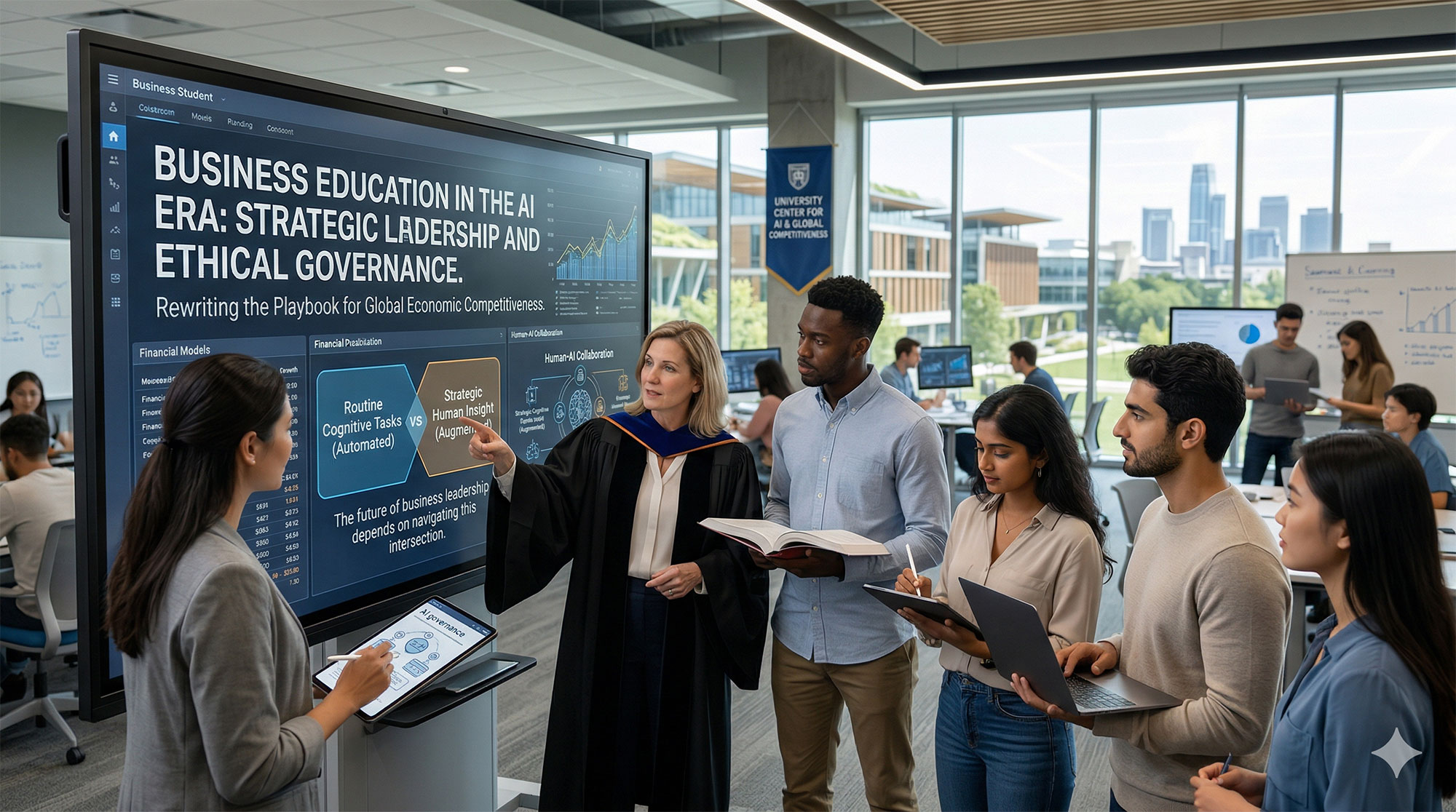
This is why the AI shift is not a threat to higher education so much as a strategic opening. Apprenticeships and on-the-job training increasingly compete with undergraduate and MBA pathways for immediate workforce readiness, but universities retain a durable advantage: the ability to produce interdisciplinary thinking, ethical judgement, strategic leadership, and the cross-pollination of ideas across finance, economics, psychology, ethics, and the hard sciences.
The Macroeconomic Opportunity
High-quality tertiary education has long been a driver of national economic strength. AI adds a new layer: the chance to accelerate growth through better human-capital allocation, faster diffusion of productivity tools, and more resilient financial systems. The World Economic Forum’s Future of Jobs Report 2025 frames the scale of the shift in labour-market terms. It finds that two-thirds of employers plan to hire talent with specific AI skills, about half intend to re-orient business operations in response, and 39 percent of core job skills are expected to change by 2030.
The upside is particularly material for emerging markets. The African Development Bank’s Africa’s AI Revolution argues that AI could add up to $1,000bn to Africa’s GDP by 2035 through inclusive deployment across agriculture, services, manufacturing, and finance, with the potential to create 35 to 40 million net new digital jobs. In Asia and the Middle East, similar dynamics are already being pursued through national programmes that treat AI literacy, governance, and ethics as a pipeline for competitiveness, not merely a technology preference.
Signals That the Skills Mix Is Shifting
| Signal | What It Implies for Business Education | Primary Source |
|---|---|---|
| 39 percent of core job skills expected to change by 2030 | Curricula must be designed for ongoing re-skilling and role fluidity | World Economic Forum |
| Two-thirds of employers plan to hire for specific AI skills | AI fluency becomes a baseline, not a specialist track | World Economic Forum |
| About 57 percent of US work hours could be automated in theory | Hard skills are repriced; judgement, oversight, and governance rise in value | McKinsey Global Institute |
| $1,000bn potential GDP uplift for Africa by 2035, with 35 to 40 million digital jobs | Leadership and financial-sector capability become convergence tools | African Development Bank |
| National AI curriculum and ethics embedded in qualifications frameworks | Policy is pulling education into a security and competitiveness agenda | SDAIA National AI Qualifications Framework |
Hard Skills Are Being Repriced
Traditional programmes long emphasised repeatable analytical work: financial modelling, data analysis, basic coding, compliance checks, and risk screening. Many of these tasks are now AI-assisted. The McKinsey Global Institute notes that today’s technologies could, in theory, automate activities accounting for about 57 percent of current US work hours. That is not a forecast of mass displacement. It is a reminder that large parts of knowledge work are becoming more tool-driven.
In banking and corporate finance, AI can draft credit models, screen thousands of opportunities, generate compliance documentation, and simulate scenarios at speed. This shifts advantage to the professionals who can test the outputs, diagnose bias, handle regulatory and reputational risk, negotiate across borders, and integrate machine-generated insights into high-stakes decision-making. Business education therefore competes less on teaching execution and more on teaching informed oversight.
The Strategic Pivot: What Business Schools Must Teach
If machines handle more execution, curricula must prioritise the human capabilities that carry the highest residual value. Three areas stand out.
Agility and lifelong learning. The ability to learn how to learn becomes a formal competency. The Future of Jobs Report 2025 highlights adaptability and resilience as fast-rising skills. Programmes can embed this through simulations, iterative assignments that require tool re-evaluation, and continuous-upskilling modules that mirror the cadence of real organisations.
AI governance and ethics. Future leaders need fluency in algorithmic bias, data privacy, intellectual property, accountability, and the societal implications of AI deployment. Several institutions are already signalling how this can be done in practice, from Chicago Booth’s MBA Applied AI concentration to INSEAD’s AI for Boards executive programme. In emerging markets, governance frameworks increasingly integrate local values and institutional realities, as explored in Lagos Business School’s AI in Nigeria whitepaper. At a national-policy level, Saudi Arabia’s approach points to the same direction of travel through the SDAIA National AI Qualifications Framework, which embeds ethics and governance within a wider curriculum strategy.
Complex problem-solving and strategic judgement. Case studies must evolve from tidy narratives into ambiguous scenarios where model outputs, stakeholder constraints, regulation, geopolitics, and ethics collide. In finance, this means training leaders to oversee AI-powered risk models while ensuring fairness, regulatory alignment, and long-term value creation.
The Enduring Strength of the Campus Ecosystem
Apprenticeships at large firms can deliver rapid onboarding and applied technical capability. Universities still do something different and economically valuable. They create networks where ideas cross disciplines, and they expose future leaders to frameworks that travel across sectors. A modern business leader cannot master finance in isolation. They must connect economics, ethics, behavioural science, technology strategy, and organisational design. Many of the most consequential innovations in fintech, sustainable investing, and AI governance have roots in interdisciplinary collaboration, which remains a comparative advantage of the campus ecosystem.
The most robust talent pipelines will therefore be hybrid: academic foundations that teach judgement and systems thinking, paired with practical AI fluency gained through structured placements, industry partnerships, and tool-based application.
A Practical Agenda for Academic Leadership
Business school leaders can translate the AI shift into measurable competitiveness gains by focusing on programme design, partnership depth, and outcome discipline.
- Embed AI literacy, governance, and ethics across the core. Treat AI as a general-purpose capability, not an elective add-on, and anchor it in accountability, bias management, privacy, and decision governance.
- Build durable industry partnerships. Use live casework, guest practitioners, joint research and structured apprenticeship pathways to keep curricula aligned with current tools and organisational realities.
- Modernise decision training for hybrid human-AI work. Shift from static case studies to simulations that force students to question outputs, manage uncertainty, and defend decisions to multiple stakeholders.
- Measure success by graduate readiness for AI-augmented roles. Track employer feedback on strategic competence, governance fluency, and real-world decision quality, alongside traditional placement metrics.
- Collaborate across borders. Share best practice between emerging and developed markets, especially where AI adoption can accelerate convergence in productivity and financial-sector capability.
The Competitive Edge, Restated
Return to the hypothesis. AI is automating the repeatable parts of knowledge work and elevating the value of oversight, judgement, ethics, and leadership. That changes what business education must deliver and what employers will pay for.
The macro stakes are high. The labour-market signals in the World Economic Forum’s Future of Jobs Report 2025, the automation potential mapped by the McKinsey Global Institute, and the growth case set out by the African Development Bank point in the same direction: economies that train leaders to deploy AI responsibly will compound advantages in productivity, resilience, and competitiveness. Those that hesitate will import capability rather than build it, and will watch gaps widen in the sectors where decision quality matters most.
You may have an interest in also reading…

China on the Way Back to Rebalancing
China’s economy keeps recovering from the coronavirus pandemic-led crisis through the third quarter of 2020, as revealed by the numbers

CFI.co Meets the CEO of Makhtag: Muhammad Halim Fidai
Former governor Muhammad Halim Fidai of the Wardak Province in Afghanistan is not impressed with the way his country is

World Bank Group: Create Jobs by Focusing Industries to be Competitive
Focusing Investment in Industries Poised for Growth Can Help Generate Jobs, Income and Wealth. By Janamitra Devan Job creation is
