







































































Energy Security and Capital Allocation: Why Geopolitics Is Accelerating the Clean-Energy Investment Cycle
The hypothesis is straightforward. When energy security becomes a first-order political priority, it pulls capital towards domestic, fuel-free electricity systems and away from import-dependent risk. In 2026, geopolitics is not only moving prices. It is accelerating the clean-energy investment cycle.
A Market Reminder of Energy Risk
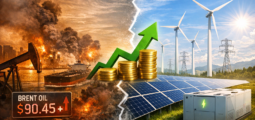
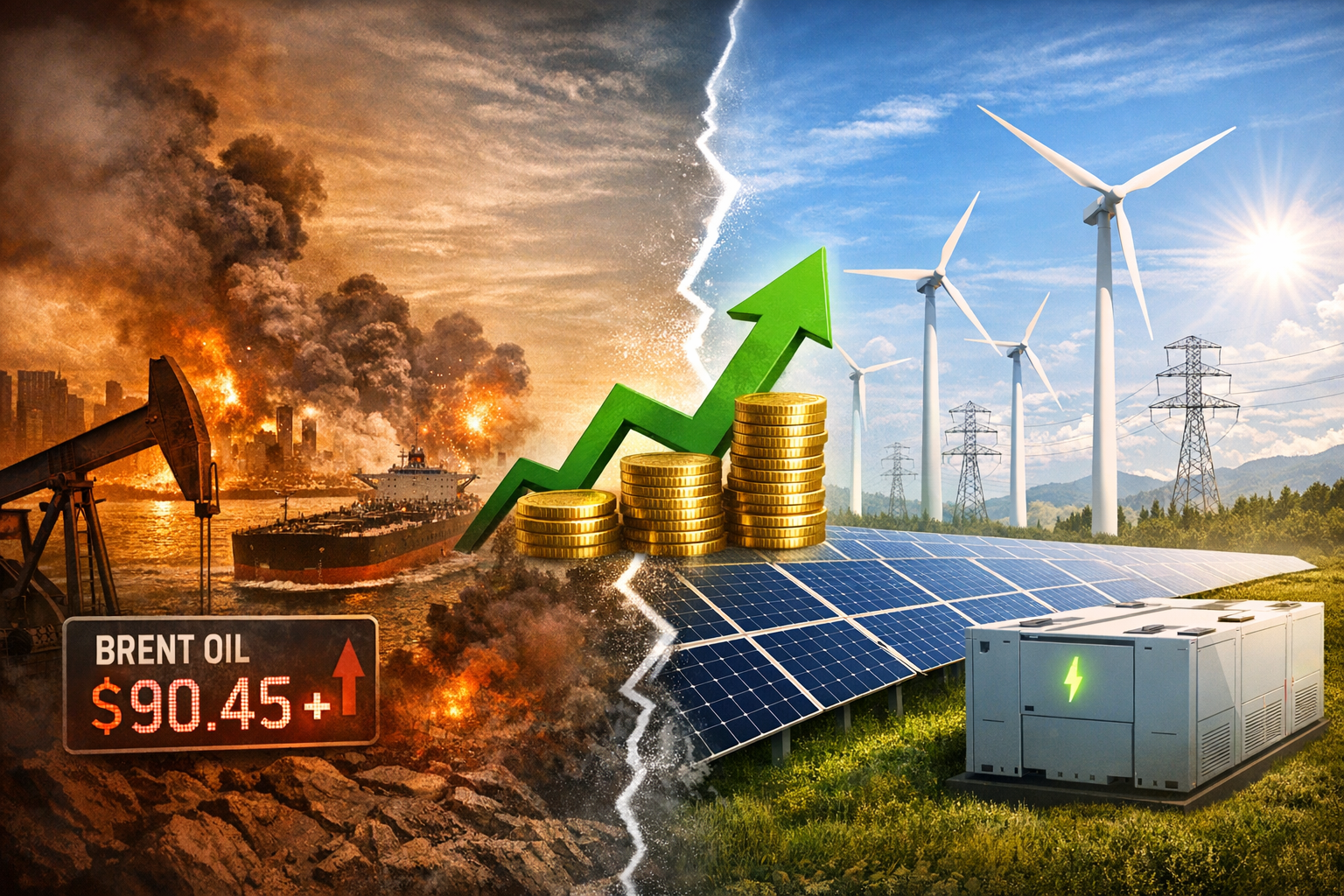
Energy markets received another reminder in early 2026 of how quickly geopolitical developments can transmit into global commodity prices. Escalating tensions in the Middle East and disruptions to shipping through the Strait of Hormuz, one of the world’s most important oil transit routes, pushed Brent crude briefly above $90 a barrel. In its Short-Term Energy Outlook, the U.S. Energy Information Administration noted that prices at one stage were about 50 percent higher than levels at the start of the year.
Episodes like this underline a persistent feature of the global energy system: exposure to geopolitical shocks and price volatility. Yet the latest disruption is also reinforcing a structural shift already under way. Capital is steadily reallocating towards renewable power, storage and electrified infrastructure, not only because of climate commitments, but because security-of-supply has become an investable thesis.
From Climate Policy to Strategic Energy Security
For much of the past decade, the energy transition was framed primarily as a climate-mitigation challenge. The strategic context has broadened. Governments now treat the composition of the energy system as a resilience question, and resilience is increasingly measured by import exposure, supply-chain vulnerability and susceptibility to global price swings.
The International Energy Agency’s work on batteries and secure energy transitions captures the underlying logic. Expanding domestic renewable generation reduces reliance on imported fossil fuels and lowers exposure to commodity-market volatility. Once built, solar and wind have no fuel costs, making them structurally less vulnerable to external shocks than conventional generation.
This shift in thinking is visible in policy frameworks. Energy independence and diversification are increasingly used to justify accelerated renewable deployment alongside emissions targets. At COP28, UN climate chief Simon Stiell warned that economies heavily dependent on fossil fuels remain exposed to geopolitical disruption and price volatility, an argument reflected across speeches and statements hosted by UNFCCC’s COP28 platform.
For investors, the significance is practical. When energy security becomes a policy priority, governments tend to introduce longer-duration incentives, procurement mechanisms and permitting reforms that increase revenue visibility for infrastructure. That can change risk-adjusted returns, particularly for assets built to run for decades.
Capital Is Already Moving
The reallocation is visible in the data. BloombergNEF’s Energy Transition Investment Trends reports that global investment in the energy transition reached $2.3trn in 2025, the highest level recorded to date. That spend spans renewable generation, electrified transport, hydrogen technologies, grid infrastructure and energy storage.
The International Energy Agency’s World Energy Investment report points to a complementary shift: global investment in electricity systems, particularly renewable generation and transmission networks, is now significantly higher than investment directed towards fossil-fuel supply. Electricity-sector investment is approaching $1.5trn a year, roughly 50 percent higher than spending on oil, gas and coal supply.
Fossil fuels remain central to the energy mix, but the direction of incremental capital allocation is increasingly tilted towards electrification and low-carbon infrastructure. The market is not eliminating hydrocarbons overnight. It is building the next growth phase around electricity, flexibility and domestic supply security.
Key Indicators of the Security-Driven Reallocation
| Indicator | Most Recent Data Point | Source |
|---|---|---|
| Global Energy Transition Investment | $2.3trn in 2025 | BloombergNEF |
| Annual Investment in Electricity Systems | Approaching $1.5trn a year, about 50 percent higher than fossil supply spend | IEA |
| Battery Pack Price Benchmark | $108 per kWh in 2025, down from above $1,000 per kWh in 2010 | BloombergNEF |
| China: New Wind and Solar Capacity Additions | About 357 GW in 2024 | Carbon Brief |
| Africa: Planned Renewables Buildout | Masdar target of 10 GW by 2030 | Masdar |
Renewables Reshaping Electricity Markets
Renewable deployment is now changing how electricity systems grow. The energy think tank Ember reports that renewable sources accounted for the majority of global electricity generation growth in 2025, driven largely by solar and wind, in its Global Electricity Review. Solar, in particular, has become the fastest-growing source of electricity generation globally for several consecutive years.
China offers the clearest illustration of scale. The country set a target of installing 1,200 GW of wind and solar capacity by 2030, a milestone analysts increasingly argue is being reached years ahead of schedule. Research compiled by Carbon Brief indicates China added about 357 GW of new wind and solar capacity in 2024 alone, an expansion unmatched elsewhere. Carbon Brief also estimates that China’s clean-energy sectors, including renewables, batteries, electric vehicles and grid infrastructure, contributed about 15.4trn yuan, around $2.1trn, to the economy in 2025, representing more than 11 percent of GDP.
The significance for capital allocation is twofold. First, renewables are no longer niche. They are shaping marginal power generation in major markets. Second, clean-energy industries are becoming macroeconomic growth engines, which strengthens the political durability of transition policy in ways that simple emissions narratives do not capture.
Storage Economics and System Flexibility
Rapid progress in energy storage is reshaping the economics of power systems. Costs have fallen dramatically as manufacturing scale has expanded and supply chains have matured. BloombergNEF estimates average battery pack prices fell to $108 per kWh in 2025, down from more than $1,000 per kWh in 2010, a benchmark referenced in its investment trends work. Much of the decline has been driven by the rise of lithium iron phosphate chemistries, which offer lower cost and longer operational lifetimes compared with earlier lithium-ion technologies.
Storage is increasingly deployed alongside renewable generation to improve grid flexibility. By shifting electricity from periods of excess output to times of higher demand, batteries help balance power systems with rising shares of variable renewables. The IEA’s security-focused framing, in Batteries and Secure Energy Transitions, positions storage not only as a decarbonisation tool, but as an enabler of domestic supply security and system resilience.
Innovation may widen the technology menu further. Sodium-ion batteries and flow-battery designs are being explored for stationary applications where cost, durability and longer discharge durations matter more than energy density. The direction of travel is clear even if forecasts remain cautious. Cheaper, longer-duration storage increases the risk that some long-lived fossil investments become underutilised or stranded, not because demand disappears, but because flexibility becomes cheaper than fuel dependence.
Emerging Markets as the Next Investment Frontier
While Europe, China and the United States have dominated renewable deployment to date, emerging markets are likely to drive much of the next phase of energy investment. The IEA notes that many of the fastest-growing electricity markets sit in Asia, Africa and the Middle East, where population growth and urbanisation are increasing demand for reliable power, a trend reflected in its World Energy Investment analysis.
Renewables in these regions are increasingly supported by international partnerships and sovereign investment initiatives. Abu Dhabi’s renewables developer Masdar has announced plans to develop 10 GW of renewable capacity in Africa by 2030, detailed in its Africa growth plan announcement. Meanwhile, developers such as ACWA Power have expanded investment in markets including Egypt, where large solar and wind projects are being built to support domestic demand and emerging green-hydrogen ambitions.
The broader pattern is that renewables are becoming intertwined with industrial strategy and economic development. In regions where energy demand is growing quickly, the choice is often not between fossil fuels and renewables in the abstract, but between importing volatility and building domestic capacity.
Institutional Capital and the Infrastructure Bid
Institutional investors are positioning themselves within this evolving landscape. Renewable projects supported by long-term power purchase agreements can provide relatively stable revenue streams over multi-decade horizons, which fits the duration profile of pension funds, sovereign wealth funds and infrastructure allocators. The investable proposition improves when policy frameworks reduce uncertainty through predictable procurement and grid-planning pathways.
Banks and development finance institutions are also scaling transition financing mechanisms designed to unlock capital in harder-to-finance markets. Standard Chartered has highlighted the financing opportunity and the need for credible structures in its work on transition finance, reflecting a wider expansion in tools such as green bonds and blended-finance models. The capital requirement remains measured in trillions, but the financing ecosystem is becoming deeper, more sophisticated and more willing to take structured risk where policy credibility is improving.
The Direction of Capital
The energy transition is often portrayed as a gradual technological evolution. The evidence of 2026 suggests a sharper dynamic. Geopolitical disruption is accelerating the pace of change by reframing clean energy as security infrastructure. Price volatility and supply risk are encouraging governments to diversify energy systems and reduce dependence on imported fuels, while technological progress continues to lower the cost of renewable generation and storage.
For investors, the implication is increasingly clear. Capital allocation across the global energy system is shifting. Renewable generation, grid infrastructure, storage systems and electrification technologies are moving from the margins of the energy sector towards its centre. Fossil fuels will remain an important part of the energy mix for years to come, but the direction of long-term investment flows suggests that the next phase of infrastructure build will be organised around electricity, flexibility and low-carbon technologies.
Return to the hypothesis. When energy security becomes a policy priority, governments tend to harden incentives, reduce uncertainty and accelerate deployment. That policy response changes the shape of risk and return. In a world where geopolitics can still push Brent above $90 a barrel overnight, the most durable hedge is a system that relies less on fuel, and more on domestic, electrified capacity.
You may have an interest in also reading…

Otaviano Canuto, World Bank Group: Macroeconomics and Stagnation – Keynesian-Schumpeterian Wars
Policy makers in the advanced economies at the core of the global financial crisis can make the claim that they
PwC: Nigeria – Prosperity Beyond Oil
PwC recently published a report in conjunction with the Lagos State Chamber of Commerce and Industry (LCCI) on the key

Empty Threats: Little to Fear from the Chattering Classes
Western intelligence services are sounding the alarm over a possible terrorist attack soon to strike Yemen or another country in
