









































































A familiar market pattern reasserted itself on 20 January 2026: the dollar slid, Treasury yields rose, US equities fell sharply, and investors rushed into precious metals. This is the classic “sell America” trade — and its reappearance says less about a single headline than about growing concern over US policy volatility.
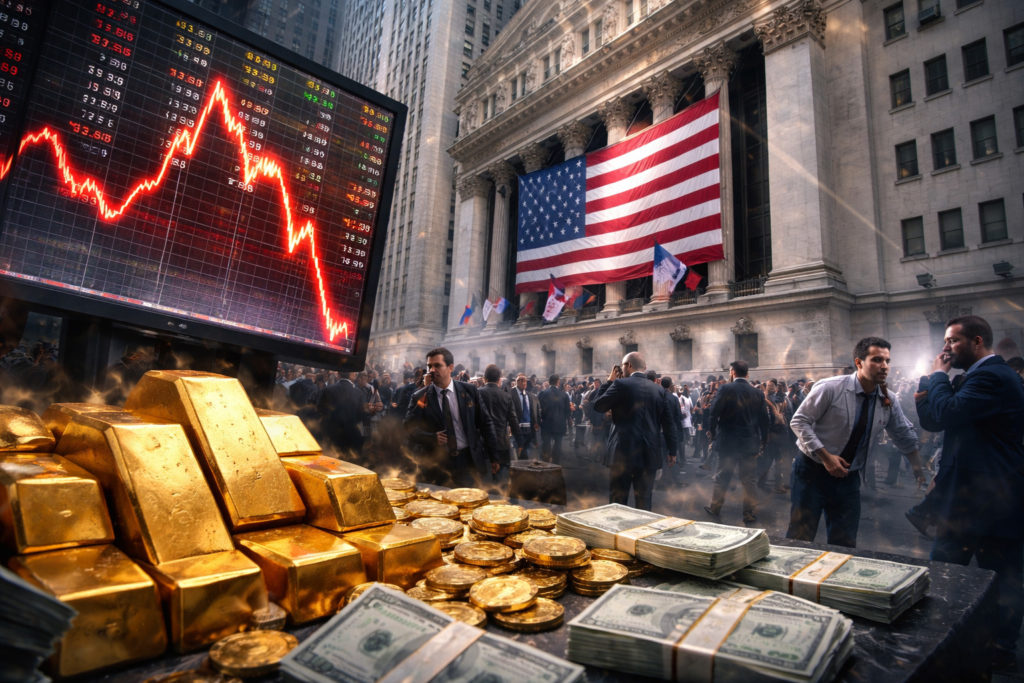
Key Points: US markets sold off sharply on 20 January 2026 as tariff threats tied to Greenland introduced a geopolitical twist; the signature move combined a weaker dollar with rising long-dated yields and falling equities; gold and silver surged as investors demanded a higher US risk premium, with the bond market emerging as the stress point.
A Tariff Shock With A Geopolitical Twist
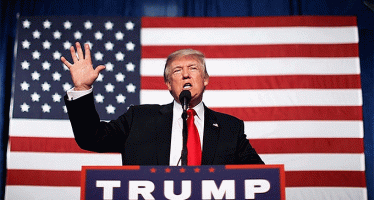
The catalyst was President Donald Trump’s renewed push to bring Greenland under US control — and, crucially for markets, the explicit linkage to trade penalties. Over the weekend, Trump threatened tariffs on eight European countries — Denmark, Norway, Sweden, France, Germany, the United Kingdom, the Netherlands, and Finland — starting at 10 percent on 1 February and rising to 25 percent on 1 June if a deal to purchase Greenland is not reached. (ABC)
Markets have long treated tariff threats as negotiable. What unsettled investors this time was the breadth of the target set — key allies and major economies — and the fact that the tariff timeline was laid out in escalating steps. The message to global capital was unmistakable: trade policy may now be used as leverage in disputes that are not, strictly speaking, commercial.
In parallel, further threats added to the sense of unpredictability. Reporting from Washington highlighted additional tariff talk directed at French wine and champagne, deepening concerns that a broader trade confrontation could spill into consumer sectors and European corporates. (The Washington Post)
The “Sell America” Signature: Weaker Dollar, Higher Yields, Lower Equities
The market response carried the distinctive fingerprints of a “sell America” episode. The dollar fell nearly 1 percent on the day, while Treasury prices dropped — an unusual and important pairing, because risk-off episodes often send money into US government debt. (The Washington Post)
Instead, the bond market became a source of stress. Long-dated yields rose sharply, with the 10-year yield reaching around 4.29 percent — described as a five-month high — while the 30-year yield jumped to roughly 4.92 percent in what was framed as its biggest single-day increase since July 2025. (MarketWatch)
This matters because higher long-term yields tighten financial conditions across the economy. They lift mortgage rates, raise corporate funding costs, and compress equity valuations — especially in growth-heavy indices. In other words, even if tariffs never materialise, the threat can generate a tangible macro tightening if it destabilises the bond market.
A Hard-Asset Scramble: Gold And Silver Surge
As confidence in policy stability wavered, investors sought safety in assets perceived as outside the political system. Gold rose about 3.7 percent to roughly $4,765 per troy ounce, while silver surged past $94, both cited as record-setting moves in the day’s coverage. (The Washington Post)
That divergence — precious metals up, equities down, and Treasuries sold — is the point. It suggests that markets were not simply reacting to weaker growth expectations. They were demanding a higher risk premium for US assets, and simultaneously seeking hedges against currency and fiscal uncertainty.
Crypto Does Not Behave Like A Haven
The day also offered a reminder that Bitcoin’s “digital gold” narrative remains conditional. Crypto weakened alongside other risk assets, with reports noting Bitcoin slipping below $90,000 as bond-market stress rippled through markets. (Yahoo Finance)
From Trade Wars To “Capital Wars”
The deeper concern behind the “sell America” trade is not tariffs alone; it is the possibility that trade disputes evolve into financial retaliation — or at least into reduced willingness to fund America’s deficits at the margin.
Ray Dalio has recently warned that trade tensions can bleed into “capital wars”, in which foreign investors become less inclined to hold US debt, potentially forcing domestic financing choices that are more inflationary or currency-negative. (Business Insider)
This fear is amplified by Europe’s scale as a holder of US assets. Recent commentary has put the spotlight on Europe’s multi-trillion-dollar exposure to US bonds and equities, raising the question of how quickly hedging behaviour or repatriation flows could change if political risk continues to rise. (Business Insider)
Why Positioning Makes This Episode More Dangerous
A decade ago, investors could treat “sell America” as a temporary squall. Today, US assets sit at the core of global portfolios. The US equity market represents roughly half of global equity value by several widely cited estimates — and in many global benchmarks, North America carries an even larger weight. (Visual Capitalist)
The TACO Question: Will The Threat Stick?
A key uncertainty is whether this becomes a sustained re-rating or another example of the market’s “TACO trade” framework — shorthand for “Trump Always Chickens Out” — the idea that tariff threats are often dialled back once financial conditions tighten and political pressure mounts. (ABC News)
Takeaway: Markets Are Pricing Governance Risk, Not Just Growth Risk
The most telling feature of 20 January’s move was the combination of outcomes: a falling dollar, rising long-term yields, a sharp equity sell-off, and surging precious metals. That alignment suggests investors were questioning the stability and predictability of US policy — and demanding compensation for holding US risk.
If the tariff timeline holds — or if retaliation becomes likely — the “sell America” trade could evolve from a day’s drama into a longer repricing of US assets. The bond market will remain the pivotal arena: it is where fiscal confidence, foreign demand, and policy credibility converge.
FAQs
What Is The “Sell America” Trade?
It is a market pattern in which investors reduce exposure to US risk assets, often expressed through a weaker dollar, falling US equities, and rising yields when confidence in policy or fiscal stability is questioned.
Why Was Greenland At The Centre Of This Episode?
Because the tariff threat was explicitly linked to a geopolitical objective — US control of Greenland — signalling that trade policy could be used as leverage in disputes that are not primarily commercial.
Why Is It Notable That Treasury Prices Fell In A Risk-Off Move?
In many risk-off episodes, Treasuries rally as investors seek safety. Here, Treasuries sold off and yields rose, suggesting the bond market itself became the stress point, tightening financial conditions.
Why Did Gold And Silver Surge?
Precious metals often benefit when investors seek hedges against currency and fiscal uncertainty. A simultaneous surge in metals alongside US asset weakness can indicate a rising risk premium for US policy volatility.
What Would Make This More Than A One-Day Shock?
A sustained repricing would likely require follow-through on the tariff timeline, signs of retaliation, or persistent evidence of reduced marginal foreign demand for US assets or increased currency hedging.
What Should Investors Watch Next?
Watch the bond market for signs of sustained yield pressure, the policy path on tariffs and exemptions, and whether broader financial retaliation fears emerge—particularly around foreign demand and hedging flows.
Sources
Publisher: CFI.co – Capital Finance International
Author: CFI.co
Section: North America
Sponsored: No
Final URL: https://cfi.co/northamerica/2026/01/the-sell-america-trade-returns-with-greenland-at-the-centre/
CFI.co Editorial Policy