

































































The Venezuela Trade: Markets Move Faster Than Politics
The overnight capture of Nicolás Maduro has jolted geopolitics — and, almost immediately, reset the investment debate around Venezuela’s reopening. For global capital, the question is no longer whether a “reconstruction trade” could exist, but what it would take for it to be investable.
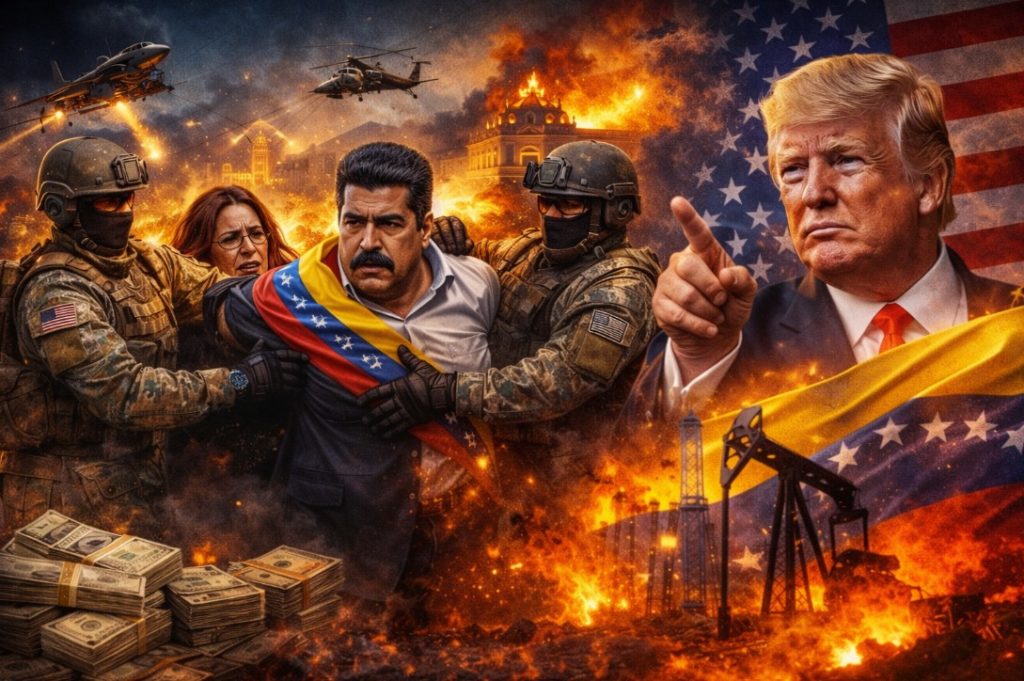
In the first days of January 2026, Venezuela shifted from chronic political risk to acute event risk. US airstrikes in and around Caracas and the reported capture of President Nicolás Maduro and his wife, Cilia Flores, were followed by remarks from President Donald Trump suggesting the United States would “temporarily take control” of Venezuela’s government until a “safe” transition could be arranged.
For investors, the speed of the narrative matters almost as much as the narrative itself. A regime long treated as immovable has suddenly become contingent — and in markets, contingency is optionality. Within hours of the news cycle hardening, conversations that had been confined to sanctions compliance teams and distressed-debt specialists widened to include energy executives, frontier-market allocators, and infrastructure capital. Venezuela’s “trade” is not a single bet; it is a stack of scenarios with dramatically different outcomes.
A “Reopening” with Real Assets — and Real Scars
Venezuela is not a blank slate in the way that some post-conflict economies are. It is, rather, a country that has been economically isolated for years while still sitting atop strategic assets. The oil and gas system is degraded, but not imaginary; the ports and pipelines exist; the country remains embedded — at least physically — in global commodity supply chains.
That distinction is crucial. Reconstruction in a place with no operating backbone can take a decade before it is financeable at scale. Reconstruction in a place with underutilised assets can move faster, provided the political and legal architecture turns from hostile to investable. That “provided” is doing a lot of work.
The Trump administration’s public framing has leaned heavily on energy infrastructure and the claim that restoring output is in the strategic interest of the United States. In remarks reported by NPR, Trump argued that US oil companies would “fix the badly broken infrastructure” and get oil “flowing” again, while US officials pointed to indictments and longstanding allegations against Maduro’s circle.
Chevron First — and Everyone Else Watching
If Venezuela genuinely reopens, the first-order beneficiaries are unlikely to be the boldest speculators. They will be the firms already inside the perimeter, already operating under licences, already managing local risk. In the US context, that begins with Chevron, the only US oil major with an active operational footprint in Venezuela in recent years. In the immediate aftermath of the strike and capture reports, Chevron’s public posture was cautious, emphasising employee safety and asset integrity rather than opportunity.
Others will watch before they move. ExxonMobil and ConocoPhillips have history in Venezuela — and scars from it. Any renewed presence would depend not only on sanctions relief, but on the credibility of contracts, the enforceability of arbitration, and the new government’s willingness to establish rules that are stable enough to survive the next electoral cycle. The “Venezuela Trade” may be born in oil, but it will only mature in governance.
The Capital-markets Aangle: Sovereign Debt as a Political Instrument
The country’s distressed sovereign debt is another pressure point — and another potential catalyst. In a stable transition scenario, debt does not simply re-rate because investors feel optimistic. It re-rates because a credible counterparty emerges, negotiations become possible, and the path to restructuring becomes legible.
But Venezuela’s debt story is not a clean technical exercise. It is political capital. A new administration would need to decide whether it wants to pursue rapid normalisation — likely requiring engagement with creditors, multilateral institutions, and a rules-based framework — or whether it wants to keep the debt problem frozen while it triages domestic stability. Markets may prefer speed; governments often prefer control.
Why Investors Care: Scale, Not Novelty
The draw is not subtle. Venezuela’s resource base and underinvested infrastructure imply a large theoretical pipeline of projects: oilfield services, midstream rehabilitation, power generation, ports, roads, mining, telecoms, and basic urban services. In bullish circles, the opportunity set is framed as one of the largest “reopening” trades of the decade — not because the assets are new, but because the discount rate has been punitive for so long.
Even so, money does not flood into countries; it floods into enforceable frameworks. The investability question will be decided by a small set of early signals: who controls the security apparatus, how quickly technocratic ministries can function, whether the central bank is insulated, and how sanctions policy evolves.
The Risk Ledger: Sanctions, Legitimacy, and the “Transition Premium”
There is also a non-trivial possibility that the market is trying to price an outcome that politics does not deliver. NPR reporting noted that Venezuela’s government condemned the US action as military aggression, while opposition voices argued that the internationally recognised election winner, Edmundo González, should assume the presidency. The same reporting captured the regional and domestic uncertainty that typically defines the first phase of a regime break.
That uncertainty creates what might be called a “transition premium”: the spread between what assets are worth in an investable Venezuela and what they are worth in a Venezuela that remains unstable, contested, or sanctioned. The premium is large — and it is not paid out smoothly. It is paid out in bursts, often around sanctions announcements, cabinet appointments, and the first credible signals of institutional repair.
For business audiences, the most practical takeaway is also the least glamorous: compliance will shape everything. Sanctions easing, licensing clarity, and bank de-risking will determine the tempo of any capital return. Even investors with strong conviction cannot deploy at scale if payment rails, insurance, and counterparties remain constrained.
What to Watch Next
The market is already attempting to run ahead. It will not stay ahead for long unless three things become clearer: the legitimacy and durability of the transition authority, the roadmap for the oil sector and public finances, and the posture of Washington and allied capitals on sanctions and recognition.
Venezuela has been socialist for nearly three decades, and the hardest work — rebuilding trust in rules — cannot be airlifted in overnight. But the roadshow has begun in spirit, if not yet in flight schedules. Institutional capital is positioning, advisers are modelling, and corporate strategists are dusting off old maps. The “Venezuela Trade” is no longer an abstract thesis. It is now a live question of sequencing: politics first, then capital — or a rush of capital that tries to force politics to keep up.
You may have an interest in also reading…

IPPC Report on Global Warming: Formidable Effort in Juggling with Fuzzy Numbers
In about 25 years the world will have used up its remaining “carbon credit” for the current century. Additional emissions

Dilma Rousseff: “You have one hour to solve this problem.”
There is no denying that the main challenges facing the Brazilian economy include the achievement of sustainable growth and the

Zurich Insurance Company: Insurance in Latin America – Economic Growth Brings New Opportunities
To continue its success story, Latin America will need to address a number of socio-economic challenges. Insurance has the potential
