








































































Countries and Oil Companies Agree to End Routine Gas Flaring
Endorsements of initiative so far represent more than 40% of global gas flaring.
 Chief executives from major oil companies joined together today with senior government officials from several oil-producing countries to commit, for the first time, to ending the practice of routine gas flaring at oil production sites by 2030 at the latest.
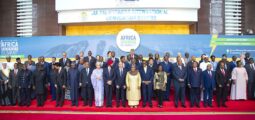
The “Zero Routine Flaring by 2030” initiative—already endorsed by nine countries, ten oil companies and six development institutions—was launched today by United Nations Secretary-General Ban Ki-moon and World Bank Group President Jim Yong Kim. They were joined by Royal Dutch Shell Chairman Jorma Ollila; Statoil CEO Eldar Sætre; Norwegian Foreign Minister Børge Brende; Gabonese Minister of Petroleum Etienne Dieudonne Ngoubou; and several other senior government and corporate officials, and representatives of international development banks. The endorsers collectively represent more than 40 percent of global gas flaring.
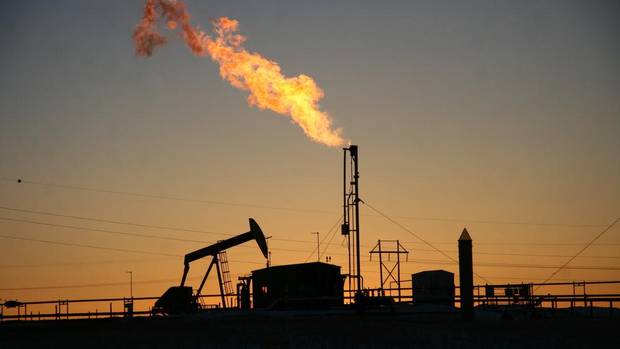
Every year, around 140 billion cubic meters of natural gas produced together with oil is wastefully burned or “flared” at thousands of oil fields around the world. This results in more than 300 million tons of CO2 being emitted to the atmosphere—equivalent to emissions from approximately 77 million cars. If this amount of associated gas were used for power generation, it could provide more electricity (750bn kWh) than the entire African continent is consuming today. But currently, the gas is flared for a variety of technical, regulatory, and economic reasons, or because its use is not given high priority.
“Gas flaring is a visual reminder that we are wastefully sending CO2 into the atmosphere,” said World Bank President Jim Yong Kim. “We can do something about this. Together we can take concrete action to end flaring and to use this valuable natural resource to light the darkness for those without electricity.”
By endorsing the initiative, governments, oil companies and development institutions recognize that routine gas flaring is unsustainable from a resource management and environmental perspective and agree to cooperate to eliminate ongoing routine flaring as soon as possible and no later than 2030. They will publicly report their flaring and progress towards the target on an annual basis. Furthermore, routine flaring will not take place in new oil fields developments. Governments will provide an operating environment conducive to investments and to the development of functioning energy markets.
“As we head towards the adoption of a meaningful new international climate agreement in Paris in December, these countries and companies are demonstrating real climate action,” said U.N. Secretary-General Ban Ki-moon. “Reducing gas flaring can make a significant contribution towards mitigating climate change. I appeal to all oil-producing countries and companies to join this important initiative.”
The World Bank has been active on this issue for 15 years, as a founding member of the Global Gas Flaring Reduction Partnership (GGFR). The Bank works with its partners in GGFR and the United Nations Sustainable Energy for All initiative (SE4All) to increase the use of associated gas by helping remove the technical and regulatory barriers to flaring reduction.
Oil companies and governments that have yet to endorse the initiative are currently undertaking comprehensive reviews of their gas flaring. Many are expected to join the Initiative in the coming months.
The following have endorsed the “Zero Routine Flaring by 2030” initiative (in order of date of endorsement received). Source
You may have an interest in also reading…

Urban Energy Efficiency Key to Mexico’s Ambitious Goals for Energy and Low Carbon Growth
Mexico sees urban energy efficiency as critical for sustainable growth, livable cities and competitiveness Ministry of Energy rolls out national

Argentina Looks to Eccentric Outlier For an Economic Fix
A far-Right libertarian candidate has burst from nowhere to claim centre stage in Argentina’s election race. Javier Milei, a 52-year-old,

Energy Security and Capital Allocation: Why Geopolitics Is Accelerating the Clean-Energy Investment Cycle
The hypothesis is straightforward. When energy security becomes a first-order political priority, it pulls capital towards domestic, fuel-free electricity systems
