










































































The Middle Power Dilemma: The UK and the Sovereignty Paradox in a Tri-Polar World
The hypothesis is simple. In a trade system increasingly shaped by the United States, China and the European Union, a country with roughly 2.1 percent of global GDP cannot rely on symbolism to secure leverage. In 2026, the UK is discovering that formal sovereignty and commercial power are not the same thing.
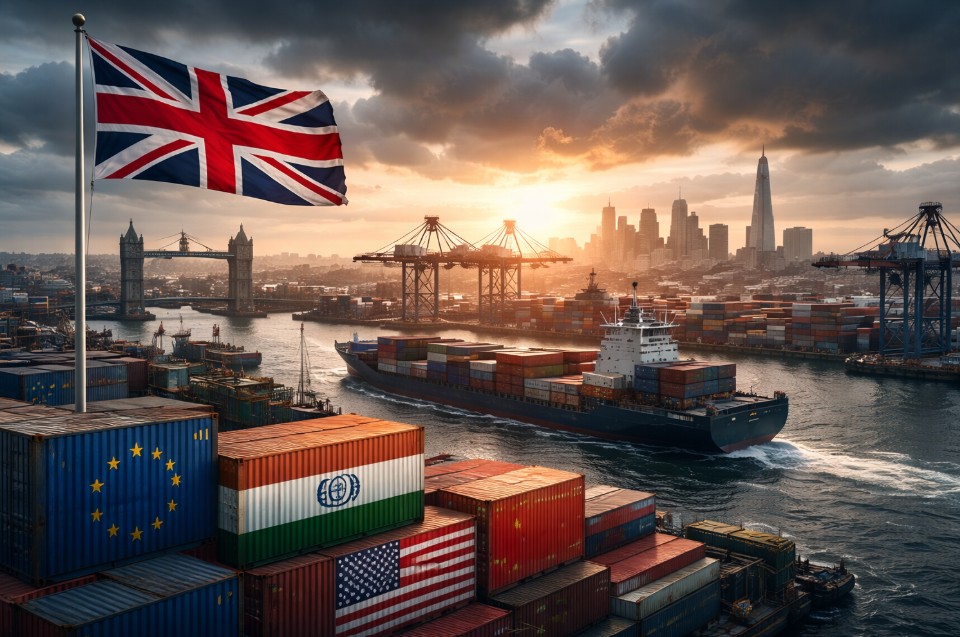
The Hypothesis: The 2.1 Percent Reality
Global trade in 2026 is being pulled towards three gravitational centres: the United States, China and the European Union. For the UK, the post-Brexit argument has shifted from the language of control to the mechanics of scale. On a purchasing power parity basis, Britain accounts for about 2.1 percent of world output, according to the IMF’s World Economic Outlook data mapper. That is large enough to matter, but too small to dictate standards to trading partners the way continental blocs can.
This is the sovereignty paradox. By reclaiming formal legal control, the UK has reduced its ability to shape the rules that govern the largest market on its doorstep. In practice, an independent middle power often moves from being a rule-maker inside a bloc to a rule-taker outside it. The issue is not patriotism. It is arithmetic.
The Rules of the Rule-Makers
In a globalised economy, standards travel further than treaties. When the largest blocs set frameworks for carbon reporting, data governance, product conformity and artificial intelligence, smaller economies face a binary choice: align, or accept friction that accumulates through procurement barriers and compliance costs. The EU’s current debate about whether Europe can “build or be bought” in AI is a reminder that regulatory and industrial policy now move together, shaping markets far beyond Brussels, as argued by Andrew Busch in Build or Be Bought: Europe’s Last Chance AI.
Britain still ranks among the world’s leading economies, but it lacks the critical mass enjoyed by China, the United States and the EU as a bloc. Even mainstream summaries of Britain’s position, such as Economy of the United Kingdom, converge on the same point: the UK is a significant economy operating in a system whose defaults are written elsewhere. The UK’s nominal GDP and growth sensitivity to global cycles are tracked continuously by data services such as Trading Economics, but the strategic problem is relative size, not absolute value.
Global PPP Share and Trading Power
| Economy/Bloc | Share of World GDP (PPP) | Global Rank (PPP) |
|---|---|---|
| China | About 19.8 percent | 1 |
| United States | About 14.5 percent | 2 |
| European Union (as a bloc) | About 13.8 percent | 3 (bloc) |
| India | About 7 to 9 percent | 4 or 5 |
| United Kingdom | About 2.1 percent | 10 |
Source: IMF World Economic Outlook, PPP share of world; contextual ranking discussion also reflected in Economy of the United Kingdom.
The India Pivot: A Tale of Two Deals
The UK achieved a significant diplomatic milestone in July 2025 with the signing of its bilateral agreement with India, described by the House of Commons Library briefing on the UK-India Free Trade Agreement as the most economically significant trade deal secured since leaving the EU. The political message was clear: Britain would strike its own path, diversify markets and turn “Global Britain” into measurable access.
In January 2026, the competitive context shifted. On 27 January, the European Commission announced the conclusion of a landmark EU-India free trade agreement. Trade observers quickly framed it as a structural event rather than a bilateral one, with commentary and early business implications captured in the Institute of Export and International Trade’s Day in Trade briefing.
This is where the middle power dilemma hardens. Britain can sign a deal with India. The EU can sign a deal with India and, at the same time, reshape the incentives faced by European supply chains that British firms still depend upon.
The EU-India Advantage
The EU-India agreement rewrites competitive conditions because it combines scale with preferential access. Analyses of the agreement have emphasised the size of the combined market and its reach across sectors, including in sector-focused trade commentary such as The EU-India Free Trade Agreement: Creating a Two-Billion-Person Market. The strategic implication is straightforward: when EU exporters receive deeper tariff relief, they can price more aggressively, invest with greater confidence, and lock in distribution channels that become harder for outsiders to displace.
In practical terms, the EU deal is expected to reduce or remove tariffs across the majority of EU goods exports to India. Where tariffs fall sharply on categories such as machinery, chemicals and high-value manufactured goods, EU suppliers gain a direct price advantage over non-EU competitors. For UK industry, the question is not whether a bilateral UK-India agreement exists. The question is whether it can be used as efficiently as the EU’s deal when the UK’s own production base remains intertwined with European inputs.
The Triangulation Trap: Rules of Origin
The most acute problem for British exporters in 2026 is not the absence of a deal, but the friction created by overlapping ones. Modern manufacturing is rarely a single-nation process. UK firms are deeply integrated into European supply chains, a reality also explored in academic work on post-Brexit supply chain impacts such as The Impact of Brexit on Companies’ Supply Chains.
Preferential tariffs depend on rules of origin. To qualify for zero-tariff access under an FTA, products must meet origin thresholds that often require substantial domestic or “originating” content. Evidence submitted to Parliament by the UK fashion and textile industry underlines how quickly this becomes a competitive constraint when EU inputs remain essential, as set out in UK Parliament Committees written evidence (UIA0030).
The trap is technical and therefore ruthless. Because the UK-India and EU-India agreements are separate legal instruments, they do not automatically permit diagonal cumulation. In other words, an EU component used in a UK factory can be treated as “non-originating” when the finished product is exported from Britain to India. That can push a product below the required origin threshold, forcing the exporter onto India’s Most Favoured Nation tariff schedule. An EU-based competitor using the same component within the bloc can qualify for preferential treatment under the EU-India deal. The mechanism is simple: the same supply chain input produces two different tariff outcomes depending on where final assembly takes place.
Specialist advisers have increasingly framed rules-of-origin strategy as central to trade competitiveness rather than an administrative afterthought, including clearBorder’s guidance on embedding rules of origin compliance in EU-UK trade strategy.
Supply Chains, Trade Patterns, and the EU Link
This asymmetry bites hardest in sectors where European integration is densest. UK trade data over the post-Brexit period points to a gradual diversification, but continued structural reliance on EU trade routes and inputs, as discussed in UK Goods Trade 2017 to 2024: From EU Reliance to a Broader Global Mix. That reliance is not ideological. It is operational.
The sectors most exposed to rules-of-origin friction also tend to be sectors where the UK competes on quality, design, engineering tolerances and integrated supply chains. When tariff outcomes start to penalise integration, firms face a choice: re-source away from the EU at higher cost, accept tariff leakage, or restructure operations to regain preferential status.
Corporate Survival and the Dutch Hub
When politics cannot quickly repair the plumbing, companies adapt. For many UK firms, the response to regulatory and customs friction has been operational relocation rather than political lobbying. EU-side warehousing, dual-entity distribution and fulfilment routing have become standard tactics for maintaining service levels and avoiding delays. Industry reporting on the evolution of post-Brexit fulfilment networks points to the growing prominence of EU hubs, including the Netherlands, as described in How UK and EU Fulfilment Networks Have Evolved Post-Brexit.
The Netherlands has emerged as a preferred base because of logistics infrastructure and proximity to ports such as Rotterdam. The logic is straightforward: inventory positioned inside the EU can be shipped as an intra-EU movement rather than as a third-country export. For UK-registered firms, this can reduce the impact of origin constraints and customs delays, effectively “Europeanising” operations to remain globally competitive. Practical customs and compliance considerations are mapped in advisory resources such as the Crowe Customs Hub.
The corporate outcome can look like resilience. The national outcome can look like leakage. When fulfilment and some operational capacity migrate to the continent, the UK retains the legal right to diverge but loses some of the industrial density that sustains competitiveness.
The 2026 TCA Review: A Window for Pragmatism
The year 2026 marks the five-year review of the UK-EU Trade and Cooperation Agreement. The case for pragmatism has strengthened as protectionism rises and supply chains are increasingly weaponised. Parliament has already framed this as unfinished business, arguing for a reset built on technical fixes in Unfinished Business: Resetting the UK-EU Relationship. Similar arguments, from outside Westminster, have been developed in reports calling for a more functional reimagining of cooperation, including Reimagining UK-EU Trade and Cooperation and trade-sector commentary such as Resetting UK–EU Trade.
The most meaningful proposals tend to be technical, which is precisely why they matter to exporters. For sectors such as food and drink, the ability to reduce sanitary and phytosanitary friction can be as important as tariff relief, a point reflected in industry positioning on India-facing trade priorities such as The Food and Drink Federation’s India trade priorities.
- Diagonal Cumulation: enabling UK, EU and shared FTA-partner content to count towards origin thresholds, reducing the penalty imposed on integrated supply chains and making UK-India preferences usable for firms with EU inputs.
- Pan-Euro-Mediterranean Convention: rejoining or aligning with PEM frameworks to harmonise origin rules across a wider regional system, with practical rule explanations outlined in Understanding the 2026 PEM Rules of Origin.
- Regulatory Alignment in SPS: establishing an SPS or veterinary agreement to reduce border friction for animal and plant products, improving predictability for exporters operating on tight timelines.
The Humility of the 2.1 Percent Reality
Return to the hypothesis. Formal sovereignty provides the legal right to act. It does not provide the economic leverage to shape the environment in which that action takes place. In 2026, the EU-India agreement shows how a larger neighbour can rewrite competitive conditions at speed, leaving British firms exposed to rules and preferences they did not design.
The outcome is not merely political. It is commercial. British exporters can find themselves acting as rule-takers from Brussels to maintain European access while becoming tariff-payers in India because their goods are not “European enough” under the legal tests that govern preferential trade. In an age of fragmentation, scale often delivers more practical advantage than the symbols of independence.
That is the 2.1 percent reality. Without deep technical alignment with larger blocs, an independent middle power risks living permanently inside the triangulation trap of its larger peers.
You may have an interest in also reading…
Otaviano Canuto: Rising Use of Local Currencies for Cross-Border Payments
At the recent BRICS summit in Johannesburg, the leaders of Brazil, Russia, India, China and South Africa said they wanted

China: The Big Spenders
Thanks to rapid urbanization and rising disposable incomes in their country, Chinese tourists spent $102 billion during their travels in

Otaviano Canuto: Macro-economic Policy Change – We’re Not in Kansas Any More
The possibility of multiple financial shocks lies ahead. Three significant changes to the macro-economic policy regime in advanced economies have
