










































































The Dissonance of Davos 2026: Capital Allocation in an Age of Fragmentation and the AI–Energy Nexus
The World Economic Forum’s 56th Annual Meeting opened beneath the banner of “A Spirit of Dialogue”. What emerged in Davos-Klosters was something sharper: a widening gap between political theatre and boardroom reality. While populist rhetoric attacked the language of climate action, capital quietly pursued an infrastructure-led energy transition—now driven less by ESG signalling than by national security, industrial policy, and the power demands of artificial intelligence.
A Spirit of Dialogue, a Climate of Tension
From January 19 to 23, 2026, Davos hosted an unusually dense concentration of political and corporate power. The mood, however, was less consensual than consequential. The forum’s own risk framing—geoeconomic confrontation, supply-chain pressure, and the weaponisation of trade—was visible not only in panel titles, but in the posture of delegations and the subtext of conversations in the corridors.
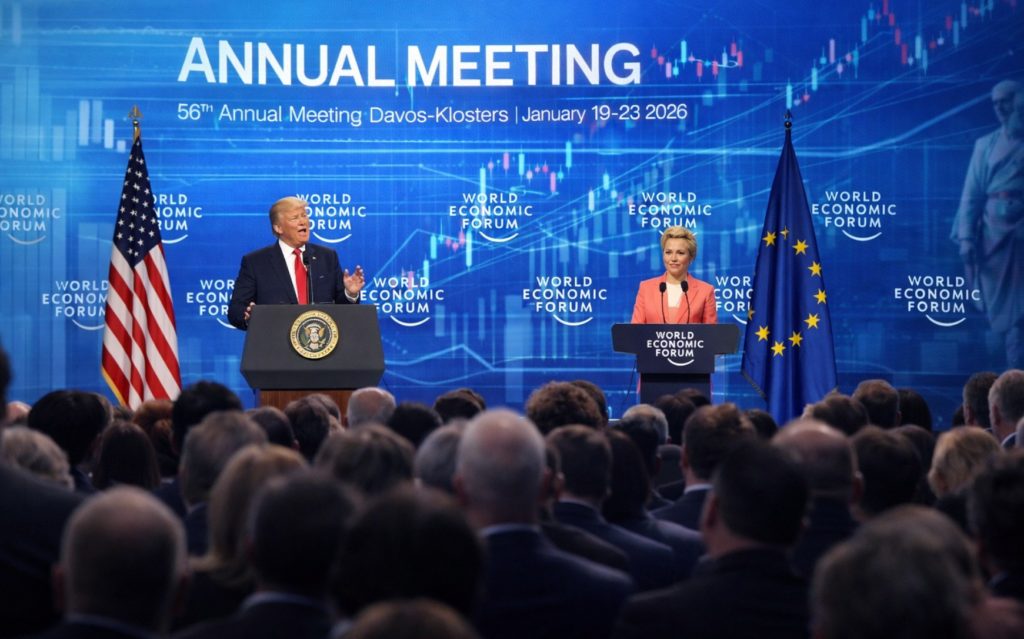
The meeting’s central contradiction was clear early. Leaders spoke publicly about cooperation in a contested world, yet much of the week revolved around managing shocks: wars, sanctions, tariffs, volatile commodity prices, and the political volatility that now travels faster than capital can hedge. In that environment, Davos functioned less as a globalist summit than as an intelligence exchange for investors and executives recalibrating to a fractured order.
“America First” Returns to the Main Stage
The defining geopolitical moment was the reassertion of an explicit nationalist agenda from the United States delegation. In Davos, the US message rejected much of the forum’s climate-forward consensus of the last decade and treated the energy transition as cultural politics rather than industrial strategy.
The language was confrontational, designed to delegitimise renewables as uneconomic and to reframe hydrocarbon extraction as prosperity. That performance played well in domestic political narratives, but it also served as a diplomatic tool: a signal that Washington intended to bargain hard on energy, trade, and industrial subsidies, even when such bargaining destabilises allied assumptions.
Yet Davos 2026 also demonstrated the limits of rhetoric as a market instrument. While public statements attacked “green” language, the private flow of capital suggested that the world’s investment logic has moved on. The decoupling between ideology and allocation was not subtle; it was structural.
Europe’s Rebuttal: Energy as Sovereignty
If the US delegation brought disruption, Europe offered consolidation. The European pitch at Davos reframed the transition away from moral argument and towards strategic necessity. The lesson of Europe’s energy shock earlier in the decade has now been absorbed: dependency is a vulnerability, and electricity systems are geopolitical infrastructure.
In that telling, renewables and grid investment were positioned as the basis of resilience and competitiveness rather than climate virtue. The European message was also defensive, reflecting anxieties about strategic exposure not only to hostile petrostates, but to the unpredictability of allies in an era of electoral whiplash. The “Green Deal” has increasingly become a sovereignty project, justified by security and price stability as much as carbon goals.
The Middle Powers and “Variable Geometry”
A notable theme in Davos diplomacy was the rise of flexible alignment. Middle powers articulated a world of shifting coalitions: different partnerships for different issues, based on overlapping interests rather than fixed blocs. In practice, this means maintaining security ties with Washington while pursuing trade, climate, and industrial partnerships with Europe and selected parts of the Global South, regardless of US political mood.
This “variable geometry” matters because it creates continuity. Even if one major player politicises climate, others can continue the buildout through coalitions of the willing. The implication for investors is that policy risk is no longer binary. The global direction remains towards electrification; the route is now multi-track.
China Steps Into the Vacuum as a “Responsible” Stabiliser
China used the forum to position itself as a defender of globalisation against protectionism. Its pitch was aimed squarely at multinationals and asset owners unnerved by tariffs and supply-chain securitisation. Beijing’s argument was that fragmentation produces no winners—and that China’s scale in clean-tech manufacturing is an enabling force for global deployment rather than a threat to be contained.
For corporate leaders, this created a strategic dilemma. The US demanded loyalty to an energy narrative anchored in fossil dominance, while China offered the industrial base of the future energy economy. Davos did not resolve that tension. It simply clarified that the contest is no longer abstract: it is being fought through factories, grids, ports, and data centres.
The Schism: Populism Versus Industrial Logic
The most consequential dynamic at Davos 2026 was not ideological conflict between nations, but the separation of public politics from private strategy. In some markets, “ESG” has become a contested label—sometimes treated as synonymous with cultural agendas rather than risk management. Yet the underlying investment thesis for the energy transition has hardened, driven by economics and physics.
Major investors and infrastructure managers increasingly describe the transition not as climate policy, but as an infrastructure supercycle. In this framing, the question is not whether the world will electrify, but whether grids, storage, and generation can scale fast enough to meet demand. Capital is behaving accordingly, focusing on assets that produce stable cashflows over long horizons: networks, power, storage, and industrial platforms.
Artificial Intelligence and the Energy Constraint
If geopolitics provided the friction at Davos 2026, artificial intelligence provided the fuel. The forum made clear that AI’s expansion is colliding with a physical constraint: electricity. Compute can scale exponentially; power systems cannot.
Technology leaders warned that future AI deployment will be determined less by algorithms than by access to reliable energy. This reality reframes clean power as a technical requirement rather than a policy preference. Data centres and advanced manufacturing increasingly require firm, low-volatility electricity—accelerating interest in nuclear, storage, and dedicated generation built close to demand.
In this context, energy has become compute infrastructure. Regions able to deliver clean, scalable power gain structural advantage, attracting investment regardless of domestic political rhetoric.
The Hard Phase of the Energy Transition
Davos 2026 underscored that the transition has entered a hard, execution-driven phase. The economics of renewable generation are largely solved; integration is not. Grid congestion, permitting delays, and transmission bottlenecks are now the primary constraints on growth.
At the same time, storage technology is advancing rapidly. Falling battery costs and expanding deployment are enabling renewable systems to provide near-baseload reliability without subsidy. Alongside storage, efficiency has re-emerged as the “first fuel”, offering rapid capacity gains in a constrained system.
These dynamics reinforce the infrastructure thesis: the transition is no longer about targets and pledges, but about steel, software, and supply chains.
Capital, Resilience, and the Energy Supercycle
Regional positioning at Davos reflected a pragmatic convergence. Emerging markets and resource exporters are seeking to convert current revenues into future-proof infrastructure. Parts of the Global South presented integrated strategies combining renewable power with digital infrastructure, appealing to both climate capital and AI-driven demand.
Europe’s southern economies highlighted a parallel logic. In an electrified world, energy-intensive industry migrates to where power is cheapest and most abundant. That reality is beginning to reverse decades of industrial offshoring, reshaping the map of production.
Conclusion: Capital Has Already Decided
The 56th Annual Meeting of the World Economic Forum may ultimately be remembered as the moment the energy transition ceased to be a political narrative and became an industrial inevitability. The contrast between rhetoric on the main stage and capital allocation behind closed doors revealed a mature market reality: investors are no longer waiting for political permission.
The “green transition” as a contested label may be fading, but the energy supercycle it described is accelerating. Driven by artificial intelligence, security concerns, and the economics of electrification, capital is flowing towards a wired, resilient, and digitised future—one that no single administration, ideology, or election cycle can meaningfully reverse.
You may have an interest in also reading…
It’s not Nuclear Physics: Pension Fund Chief Champions Ethics and Balance
Matthew Eyton-Jones is the CEO of a pension fund with a difference: it provides benefits to the staff and fellows

All Eyes on Greece: Is the IMF Asking for More than PM Tsipras Can Deliver?
Financial markets around the world slipped today on growing fears that Greece may be unable to reach an agreement with
BBE’s CEO & MD Victor van der Kwast: AI is Certainly Coming to Banking Sector — It’s All About Integration
BBE’s CEO and managing director Victor van der Kwast initiated an all-encompassing, digitally focused transformation journey in 2020. It has
