




























































Rolex vs Watch Flippers: How Certified Pre-Owned Became a Weapon of Pricing Power
Rolex has finally confronted the watch flipper economy — not by flooding the market or cutting prices, but by tightening control over trust in a resale ecosystem awash with counterfeits and speculation. The brand’s Certified Pre-Owned programme has become less a commercial sideline than a strategic tool: reinforcing credibility, resetting the value narrative, and preserving the aura that keeps demand structurally ahead of supply.
For years, Rolex has lived with an uncomfortable paradox. It sells roughly 1.2 million watches a year and commands an estimated 32 percent share of the global luxury watch market, yet demand continues to exceed supply. That imbalance has not merely lifted prices; it has fuelled a parallel economy of flippers, grey-market dealers and counterfeiters — all trading on the Rolex name, often with minimal accountability.
In that environment, resale prices function as a global scoreboard. They signal desirability, but they also broadcast volatility, distort perceived value, and invite criminal imitation. For a brand built on durability and discretion, the reputational risk is not theoretical. It is systemic. Rolex’s response was not to wage war on the secondary market, but to professionalise it.
Three years ago, Rolex launched its Certified Pre-Owned (CPO) programme as the global market for used Swiss watches approached $25bn annually. The timing was deliberate. Pre-owned had matured from informal trade into a structured asset class, increasingly driven by investment logic as much as personal taste. By stepping into the resale channel, Rolex was acknowledging a reality many luxury brands have avoided: secondhand is no longer a footnote. It is a pillar.
On paper, the programme looks like a commercial opportunity. WatchCharts estimates it will generate more than $500m in sales in 2025. Watches of Switzerland has told investors that certified pre-owned Rolex models are now its second-biggest seller. Yet the economics are not the core objective, and Rolex appears content for the initiative to be only marginally profitable — or even break-even — by design.
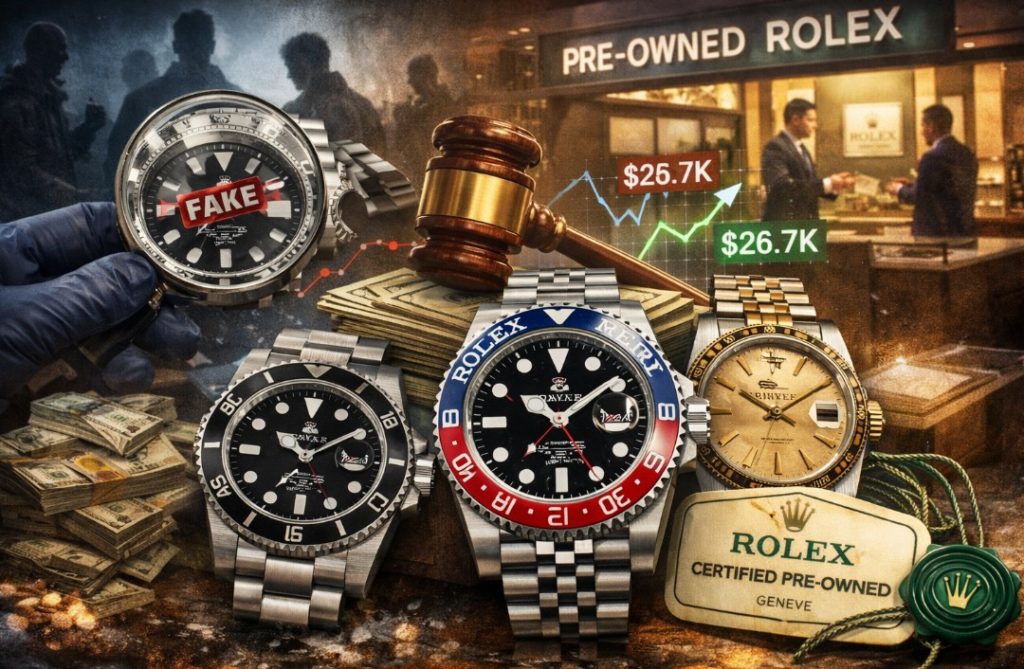
The real prize is pricing power, expressed through trust. Buyers are willing to pay about 28 percent more for a used Rolex that has been authenticated and serviced to Rolex standards, backed by a two-year warranty. In certain models, the premium is far larger. A new GMT-Master II “Pepsi” retails at roughly $12,150, trades around $22,750 on resale sites, and clears closer to $26,750 when Rolex-certified. The delta is not about metal or mechanics. It is about assurance — and the brand has monetised assurance without ever holding the inventory.
That last point is the strategic elegance. Rolex remains deliberately hands-off. Authorised dealers source the watches, authenticate and service them according to Rolex requirements, and set the resale price. Rolex’s role is certification: a seal of authenticity, plus the warranty that turns a risky purchase into a bankable one. Dealers capture the economics. Rolex captures something more valuable: the right to define what “real” looks like in the market.
This structure also avoids the pitfalls that have tripped up other maisons. Brands that attempt to police resale pricing directly risk backlash, accusations of manipulation, and the operational burden of managing inventory. Rolex sidesteps those hazards. It adds friction for counterfeiters and speculators while insulating itself from inventory risk and reputational blowback. It is influence without exposure.
Zoom out and the strategic logic sharpens. Rolex is protecting the long-term integrity of its brand in an era where digital marketplaces, social media and price-tracking platforms have made resale values instantly visible. When secondary prices rise too far above retail, the brand risks appearing inaccessible and gamified. When counterfeits proliferate, the brand risks dilution. Rolex’s CPO programme does not eliminate these pressures, but it channels them — shifting power back towards authorised networks and away from anonymous intermediaries.
The broader implication is not limited to watches. Luxury brands are discovering that resale is now too large to ignore — and too consequential to leave unmanaged. If buyers will pay a premium for a guaranteed Rolex, they will likely do the same for other high-value goods where authenticity, provenance and condition are central to value. The lesson is not that luxury should “embrace flippers”. It is that luxury should make trust the product.
Rolex has offered a blueprint: squeeze out counterfeiters, stabilise perception, and extract a premium from certainty — all without cutting prices or manufacturing more supply. In the long run, it is not the speculator who wins. It is the brand that controls the definition of authenticity.
You may have an interest in also reading…

Filippo Surace: The Visionary Behind Italy’s Healthcare Venture Revolution
From surgeon to life sciences entrepreneur, Filippo Surace is charting a new course for healthcare innovation—one that connects academic brilliance
From Davos to Digital Transformation: The Key Trends that Will Define the Global Financial Services Sector in 2024
World leaders gathered at the Davos World Economic Forum in January and told us what we already know – that

Energy for the Masses: Raiders of the Lost Promise – The Holy Grail of Nuclear Fusion
All You Ever Wanted to Know about Stellarators and Tokamaks The vast amounts of energy released by splitting the atom
