








































































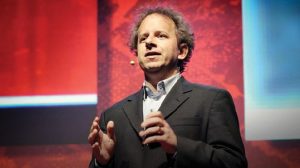
Jeremy Howard: Make Way for the Smart Machine
 Uber cabbies may have built their careers on modern technology, their job prospect is none too bright all the same. While old-school drivers wielding clubs pose the immediate threat to life, limb, and headlight; it is the robots who will do them in.
Over the next twenty odd years, robots are set to replace human workers in almost half the world’s professions and trades. Please direct any anger at Jeremy Howard. He is the one teaching robots how to run the world – or at least 50% of it.
A leading authority on machine learning, Mr Howard develops highly complex algorithms that enable innate objects to learn from data. As machines gather data through a multitude of inputs, this flow of information is then stored, compartmentalised, analysed, and otherwise processed and used to expand the device’s situational awareness and its responses to changing externalities. Machine learning begets artificial intelligence (AI).
Mr Howard is after the holy grail of AI: the point at which machine learning becomes akin to a self-fulfilling prophecy and the rate of data acquisition and processing takes off in a vicious – and hopefully benevolent – circle of learning that allows the contraption to become as smart as a human being, if not considerably more so.
Technology is not quite there yet, but it is catching on at a disconcertingly fast and dizzying pace. Late last year, Mr Howard founded a company that will try to apply machine learning and deep learning technology to medical tools used for the diagnosis of illness and disease. Mr Howard is convinced that machines are already now vastly better than humans at collecting and analysing medical data and thus able to set a much more accurate diagnosis.
“Medical diagnostics is, at its heart, a data problem. Recent machine learning breakthroughs have shown that computers can rapidly turn large amounts of data into deep insights, and find subtle patterns.”
With his start-up company, Mr Howard makes no secret of the fact that he hopes to emulate Star Trek’s Dr Spock – the endearing Vulcan addicted to high logic – who worked his medical magic aboard Starship Enterprise with the help of Data, a Soong Type android with scanning powers and a positronic brain that can access all information ever generated. Data unfailingly sets diagnoses with pinpoint precision, devoid of any and all human idiosyncrasies. This certainly seems to facilitate the healing and recovery of frail human bodies.
Meanwhile back in Australia, Jeremy Howard continues his esoteric pursuits by coupling big data to another relatively obscure science – deep learning, on offshoot of machine learning – in an attempt to make sense of the universe. With fellow Australian Brian Schmidt, an astrophysicist and Nobel Laureate, Jeremy Howard is developing ways to have machines, rather than humans, unlock the secrets of the universe.
All this heady stuff also has more down-to-earth applications such as self-driving vehicles and real-time translations generated by machines and delivered in a natural sounding humanoid voice. While Google is busily bolting together the driverless car, Microsoft-owned Skype has been tinkering with translation algorithms based on deep learning principles in order to finally demolish the Tower of Babel and have the world talking again.
In between his research into robotics and AI, Mr Howard has also found time to develop a new way of acquiring basic Chinese language skills in under a year. Geared towards humans, his model is named spaced repetitive learning and prompts learners to remember information just moments before forgetfulness kicks in. It also has the power to become excessively annoying.
However, Mr Howards readily admits that his novel approach to language learning may have a limited shelf life as Skype will have us shortly speaking Chinese and any other language without breaking a sweat.
You may have an interest in also reading…

There’s an App for That…
Is the universal digitalisation of services turning consumers into unpaid admin staff? With a mobile application available for almost every

Diversifying Economies via Tech Hubs: Middle East on the Ascent
The region, long linked with abundant energy resources, is undergoing a tremendous shift… Recognising the need to diversify their economies
Synthetic Methane’s Opening Window for Investors and Policy Makers
Synthetic methane is moving from technical curiosity to investable relevance because it offers something rare in the transition: a lower-carbon
