










































































Indonesia To Top “Happy Index”
Indonesian are the world’s most content people according to new research.
Emerging markets and half of the BRIC economies (represented by India 2nd, and Brazil 4th) are top 4 in the recently published well-being or “Happiness” ranking. Mexico came 3rd.
The Economist reports (25/02/12):
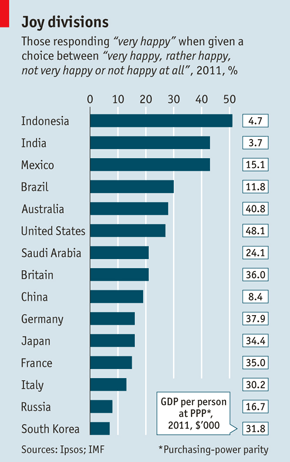
“DESPITE global economic gloom, the world is a happier place than it was before the financial crisis began. That is the counterintuitive conclusion of a poll of 19,000 adults in 24 countries by Ipsos, a research company. Some 77% of respondents now describe themselves as happy, up three points on 2007, the last year before the crisis. Fully 22% (up from 20%) describe themselves as very happy—a more important measure, says Ipsos’s John Wright, since whenever three-quarters of people agree on anything, “you need to pay attention to intensity in the results.”
All such polls come with a health warning. The level of happiness is self-reported—and the term means different things to different people. The Ipsos poll, measuring degrees of happiness, is not strictly comparable with those that ask about “well-being” (such as Gallup) or “life satisfaction” (the World Values survey), so it is hard to test the validity of the conclusions against other efforts. The margin of error is wide, at plus or minus 3.1 points for most countries. Still, Ipsos has been doing its survey regularly for five years and the figures have proved fairly stable during that time, not wildly volatile which they would have been if they had been flaky.
Two conclusions emerge. Large, fast-growing emerging markets do not share rich industrialised countries’ pessimism. The already large “very happy” cohort rose 16 points in Turkey, ten points in Mexico and five points in India. Even rich-country pessimism is uneven. The share of “very happy” people rose six points in—of all places—Japan, defying tsunami and nuclear accidents. But growth amid global misery does not explain everything: the biggest falls in happiness also occurred in large emerging markets, in Indonesia, Brazil and—a perennial miseryguts—Russia.
The second conclusion challenges the received notions of mankind’s moods. A tenet of political science is that happiness levels rise with wealth and then plateau, usually when a country’s national income per head reaches around $25,000 a year. “The richer a country gets,” argued Richard Wilkinson and Kate Pickett in “The Spirit Level”, an influential book of 2009, “the less getting still richer adds to the population’s happiness.” Many on the left have concluded that pursuing further economic growth is pointless. Even right-wing politicians such as Britain’s prime minister, David Cameron, and the French president, Nicolas Sarkozy, have set up projects to study “gross national happiness”.
But the Ipsos study shows the highest levels of self-reported happiness not in rich countries, as one would expect, but in poor and middle-income ones, notably Indonesia, India and Mexico. In rich countries, happiness scores range from above-average—28% of Australians and Americans say they are very happy—to far below the mean. The figures for Italy and Spain were 13% and 11% (Greece was not in the sample). Most Europeans are gloomier than the world average. So levels of income are, if anything, inversely related to felicity. Perceived happiness depends on a lot more than material welfare.
Two conclusions emerge. Large, fast-growing emerging markets do not share rich industrialised countries’ pessimism. The already large “very happy” cohort rose 16 points in Turkey, ten points in Mexico and five points in India. Even rich-country pessimism is uneven. The share of “very happy” people rose six points in—of all places—Japan, defying tsunami and nuclear accidents. But growth amid global misery does not explain everything: the biggest falls in happiness also occurred in large emerging markets, in Indonesia, Brazil and—a perennial miseryguts—Russia.
The second conclusion challenges the received notions of mankind’s moods. A tenet of political science is that happiness levels rise with wealth and then plateau, usually when a country’s national income per head reaches around $25,000 a year. “The richer a country gets,” argued Richard Wilkinson and Kate Pickett in “The Spirit Level”, an influential book of 2009, “the less getting still richer adds to the population’s happiness.” Many on the left have concluded that pursuing further economic growth is pointless. Even right-wing politicians such as Britain’s prime minister, David Cameron, and the French president, Nicolas Sarkozy, have set up projects to study “gross national happiness”.
But the Ipsos study shows the highest levels of self-reported happiness not in rich countries, as one would expect, but in poor and middle-income ones, notably Indonesia, India and Mexico. In rich countries, happiness scores range from above-average—28% of Australians and Americans say they are very happy—to far below the mean. The figures for Italy and Spain were 13% and 11% (Greece was not in the sample). Most Europeans are gloomier than the world average. So levels of income are, if anything, inversely related to felicity. Perceived happiness depends on a lot more than material welfare.”
You may have an interest in also reading…

A Handbag’s World: How Hermès Handbags Became Blue-Chip Assets
A new kind of currency has emerged in high finance—soft to the touch, exquisitely crafted and wrapped in mystique. The

David Ogilvy, the Original Mad Man: The Man Who Sold Selling
He revolutionised advertising with intelligent, witty campaigns and a deep respect for the consumer. David Ogilvy, often called the “Father

NBG Securities: Redefining Investment Services with a Vision for Growth
As a subsidiary of the National Bank of Greece, NBG Securities has evolved into a top-tier brokerage firm, leveraging its
